Unsteady Laminar Vortex Shedding (von Karman Street)
A step-by-step tutorial for a time-accurate unsteady incompressible simulation in code_saturne: the laminar von Karman vortex street behind a 2D circular cylinder at \(Re = 120\). The flow sheds a periodic, alternating street of counter-rotating vortices. The tutorial's purpose is the unsteady workflow: drive a time-accurate run to a statistically periodic state, extract the shedding frequency from the lift signal with a small user routine plus an FFT, and validate the resulting Strouhal number against the classical Williamson correlation.
Maintained by Simvia, part of the tutoriel-code_saturne collection.
Learning objectives
After completing this tutorial you will be able to:
- Set up a 2D unsteady incompressible laminar simulation on an imported mesh, advanced with a constant time step and SIMPLEC coupling.
- Recognise when a self-sustained instability has reached a statistically periodic limit cycle, and flush the initial transient before taking statistics.
- Add a
cs_user_extra_operationsroutine that integrates the boundary stress over the cylinder to record the lift coefficient \(C_L(t)\). - Extract the vortex-shedding frequency by FFT of \(C_L(t)\) and form the Strouhal number \(St = fD/U_\infty\), then compare it with reference data.
Prerequisites
| Requirement | Detail |
|---|---|
| code_saturne | v9.1 |
| Background | Basic incompressible solver usage (see Inc_Laminar_Step) |
If code_saturne is not yet installed, build it from the official homepage, pull a ready-to-use Singularity image from the Open Simulation Center, or pull the Simvia Docker image before continuing.
Case files
Inc_Von_Karman/
├── CASE/
│   ├── DATA/setup.xml                    # pre-configured GUI case
│   └── SRC/cs_user_extra_operations.cpp  # records the lift coefficient Cl(t)
├── MESH/
│   └── cylinder_wake.msh                 # 2D C-grid around the cylinder (Git LFS)
├── FIGURES/                              # figures used in this README
└── README.md
The mesh is tracked with Git LFS. The only user code is the lift-coefficient probe.
Physical model
The flow is 2D, unsteady, incompressible and laminar, governed by the unsteady Navier-Stokes equations,
Above a critical Reynolds number (\(Re \approx 49\)), the steady wake becomes absolutely unstable and the cylinder sheds a periodic street of counter-rotating vortices: the von Karman street. At \(Re = 120\) the shedding is laminar and strictly periodic, so no turbulence model is used (molecular viscosity only). The instability is self-sustained: from a uniform start it grows out of numerical asymmetry over a few cycles and saturates into a limit cycle.
The shedding is characterised by the Strouhal number
with \(f\) the shedding frequency, \(D\) the cylinder diameter and \(U_\infty\) the free-stream velocity. The lift coefficient \(C_L = F_L / (\tfrac12 \rho U_\infty^2 D)\) oscillates at the shedding frequency \(f\) (the drag oscillates weakly at \(2f\)), which is why \(f\) is read from \(C_L(t)\).
Flow parameters
| Quantity | Symbol | Value | Source in setup.xml |
|---|---|---|---|
| Density | \(\rho\) | \(1.0\ \mathrm{kg\,m^{-3}}\) | fluid_properties/density |
| Dynamic viscosity | \(\mu\) | \(1\times10^{-5}\ \mathrm{Pa\,s}\) | molecular_viscosity |
| Kinematic viscosity | \(\nu = \mu/\rho\) | \(1\times10^{-5}\ \mathrm{m^2\,s^{-1}}\) | derived |
| Free-stream velocity | \(U_\infty\) | \(0.12\ \mathrm{m\,s^{-1}}\) | inlet/velocity_pressure/norm |
| Cylinder diameter | \(D\) | \(0.01\) m | mesh |
| Reynolds number | \(Re = \rho U_\infty D/\mu\) | \(120\) | derived |
Geometry and boundary conditions
The domain is a 2D slice around a circular cylinder of diameter \(D = 0.01\) m centred at the origin. A C-grid wraps the cylinder (an O-grid layer resolves the boundary layer, refined into the wake) inside a rounded box: the curved inlet stands \(15D\) upstream, the flat lateral symmetry boundaries are \(15D\) above and below, and the outlet is \(75D\) downstream to let the street convect out without reflecting. The two spanwise faces (front, back) carry a symmetry condition, so the computation is effectively two-dimensional.
| Boundary | Nature | Prescribed | Zone id |
|---|---|---|---|
farfield_in |
inlet | uniform \(U_\infty = 0.12\) m/s along \(x\) | 1000 |
farfield_side |
symmetry | lateral free-stream boundary | 1001 |
farfield_out |
outlet | \(p = 0\), zero-gradient velocity | 1002 |
cylinder |
no-slip wall | \(\mathbf{u} = 0\) | 1003 |
front, back |
symmetry | spanwise planes (2D) | 600, 601 |
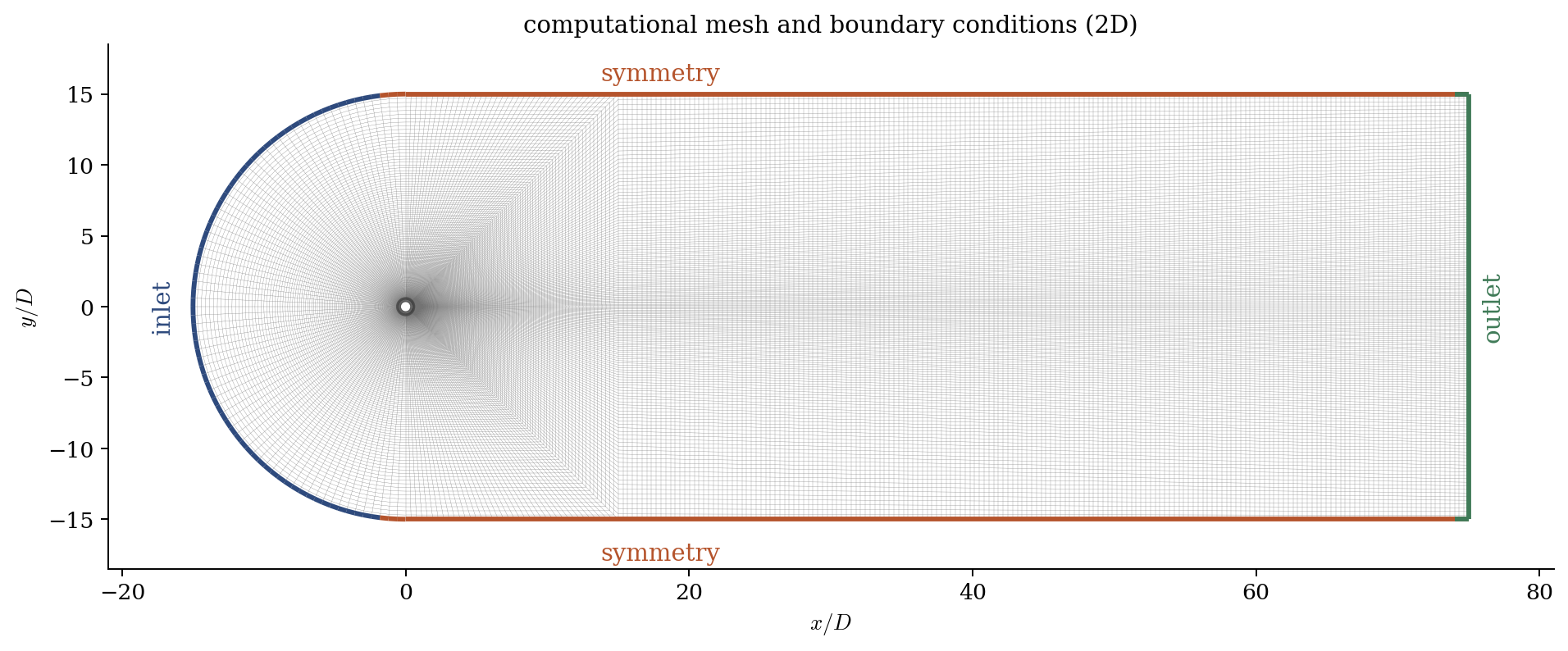
Figure 1: the computational mesh and boundary conditions (coordinates normalized by the diameter $D$). The C-grid wraps the cylinder with an O-grid boundary layer and refines into the wake; the curved inlet (blue) is $15D$ upstream, the lateral symmetry boundaries (orange) are $\pm 15D$, and the outlet (green) is $75D$ downstream.
Numerical setup
| Setting | Value | Rationale |
|---|---|---|
| Coupling | SIMPLEC | robust segregated incompressible coupling |
| Convection scheme | 2nd-order centred (with slope test) | low numerical diffusion, to preserve the shed vortices |
| Time scheme | 1st-order implicit Euler (\(\theta = 1\)) | robust unconditionally-stable transient advance |
| Time step | constant \(\Delta t = 5\times10^{-3}\) s | uniform, time-accurate advance of a periodic flow |
| Physical time | \(15\) s (\(3000\) steps) | reaches and samples the limit cycle |
| Turbulence | none (laminar) | \(Re = 120\) is below transition |
| Initialization | \(\mathbf{u} = (U_\infty, 0, 0)\) | uniform free-stream start |
The convection of momentum uses the code_saturne default centred second-order scheme (blending factor blencv = 1, ischcv = 1) with a slope test, chosen because a diffusive first-order upwind scheme would smear the shed vortices and depress the shedding frequency. Time is advanced with the first-order implicit Euler scheme.
The shedding period is \(T = 1/f \approx 0.5\) s, so \(\Delta t = 5\times10^{-3}\) s gives about 100 time steps per cycle, comfortably resolving the periodic dynamics. A monitoring probe in the wake at \((x, y) = (0.15, 0)\) m tracks the transition to the periodic state: its signal is not constant but becomes periodically stable once the street is established.
Running the simulation
The commands below start from the tutorial directory.
Graphical interface
code_saturne gui CASE/DATA/setup.xml &
The GUI opens the pre-configured setup.xml; launch with the Run button (set the number of processes under Calculation management for a parallel run).
Command line
cd CASE
code_saturne run                 # serial
code_saturne run --n 4      # parallel
Each run writes a timestamped CASE/RESU/<id>/ with run_solver.log, monitoring/probes_*.csv, the EnSight fields in postprocessing/, and the cl_profile.dat written by the user routine.
Results and verification
Once the transient is flushed, the wake settles into the periodic von Karman street: a staggered double row of counter-rotating vortices convected downstream.
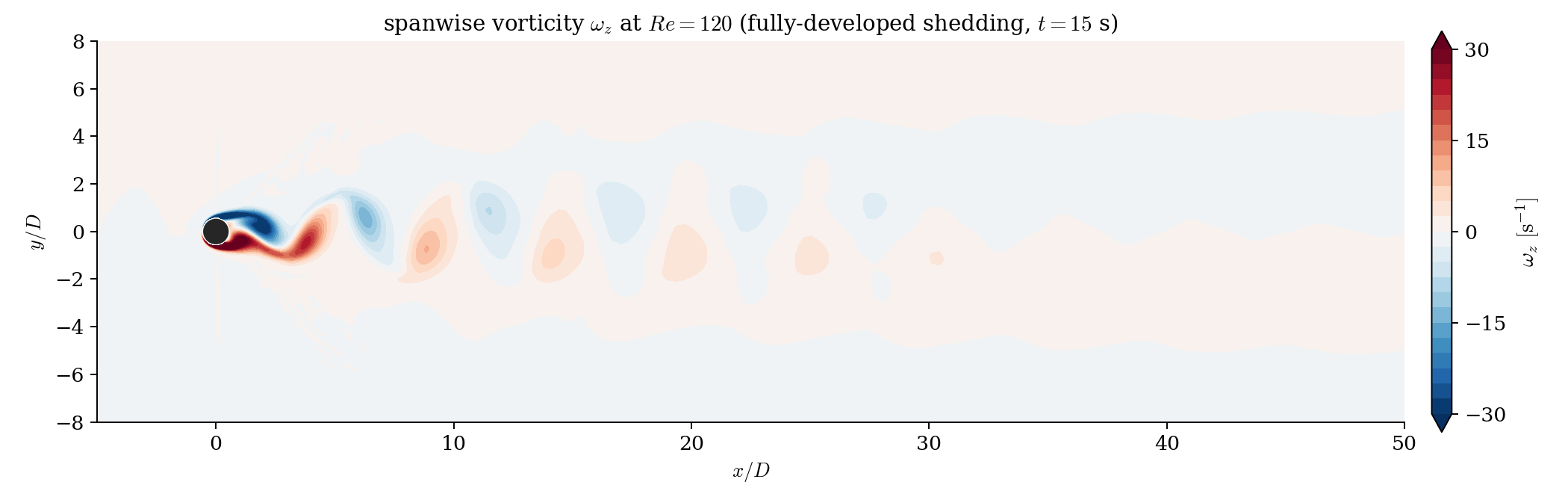
Figure 2: spanwise vorticity $\omega_z$ at $Re = 120$ (fully-developed shedding), axes normalized by $D$. Alternating positive (red) and negative (blue) vortices form the staggered Karman street, shed at the frequency $f$ and convected downstream where they slowly diffuse.
Extracting the Strouhal number
The user routine cs_user_extra_operations.cpp records the lift each time step: it retrieves the boundary_stress field, sums the stress times face area over the cylinder zone to get the aerodynamic force, projects it onto the lift direction \((0, 1, 0)\), non-dimensionalizes by \(\tfrac12 \rho U_\infty^2 D\), and appends the physical time, force and \(C_L\) to cl_profile.dat. An FFT of \(C_L(t)\), taken over the saturated window, gives the dominant frequency and hence \(St = fD/U_\infty\).
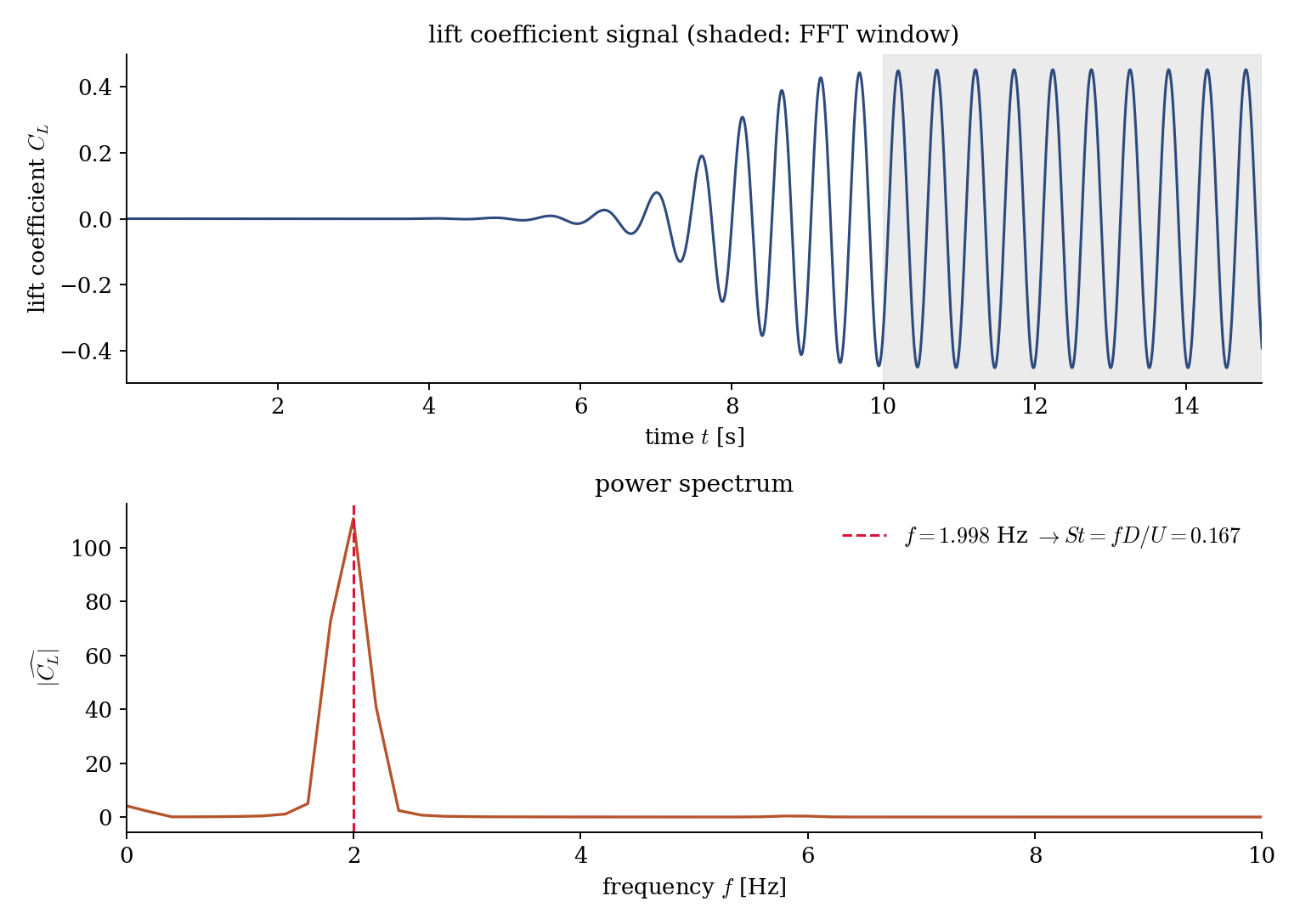
Figure 3: lift coefficient $C_L(t)$ (top) and its power spectrum (bottom). The signal grows out of the initial transient and saturates into a clean limit cycle; the FFT, taken over the shaded window ($t \geq 10$ s), peaks at $f \approx 2.0$ Hz, giving $St = fD/U_\infty = 0.167$.
Comparison with reference data
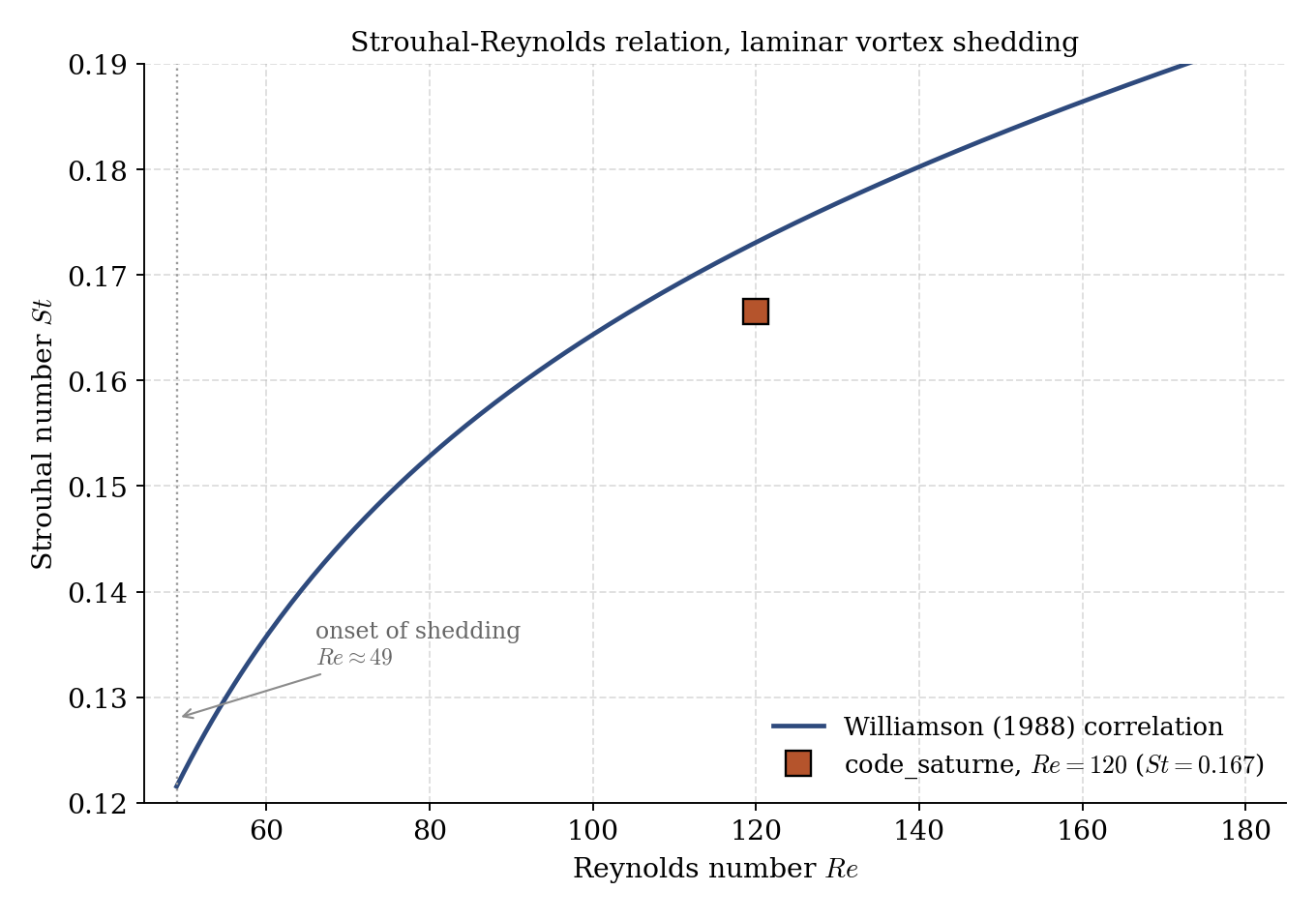
Figure 4: the computed Strouhal number against the Williamson (1988) laminar-shedding correlation. At $Re = 120$ the run gives $St = 0.167$, about $4\%$ below the correlation value ($St \approx 0.173$).
The computed \(St = 0.167\) reproduces the shedding frequency to within about \(4\%\) of the Williamson correlation. The small under-prediction is the expected consequence of this deliberately compact foundation setup: the lateral boundaries stand at \(\pm 15D\), so a mild blockage slightly lowers the shedding frequency, and the near-wake mesh is coarse. The workflow, not a converged \(St\), is the point: drive an unsteady flow to its limit cycle, measure a force history through a user routine, and recover a physical frequency by spectral analysis.
Summary
This tutorial ran a time-accurate unsteady incompressible simulation of the laminar von Karman street behind a cylinder at \(Re = 120\), advanced with a constant time step and SIMPLEC. A cs_user_extra_operations routine recorded the lift coefficient, whose FFT over the saturated limit cycle gave the shedding frequency and a Strouhal number \(St = 0.167\), within about \(4\%\) of the Williamson correlation. The lesson that carries beyond this case: for a self-sustained unsteady flow, flush the transient before taking statistics, and read frequencies from a force signal rather than from a single probe.
References
- C. H. K. Williamson. Defining a universal and continuous Strouhal-Reynolds number relationship for the laminar vortex shedding of a circular cylinder, Physics of Fluids 31, 2742-2744, 1988.
- code_saturne documentation
Authors
Simvia, from an initial setup by Abderrazak (Simvia intern). Questions, remarks and requests are welcome.