Two-Way Coupling: a Sheet of Sand Moves the Air
In a Lagrangian computation the fluid exerts a drag force on every particle. One-way coupling stops there: the particle feels that force, but the equal and opposite reaction is never applied to the fluid. Two-way coupling applies it, as a momentum source in the cells the particle crosses.
That reaction is negligible when the particles are few, and decisive when their mass approaches the mass of fluid around them, because it then changes the very flow that carries them.
This case is built to make the difference plain. Sand grains are released from a patch at the top of a box of still air, and the case is run twice, changing only the coupling. Nothing else could set the air in motion: the box is walled on every side, with no inlet, no outlet and no moving wall for the fluid. So in one-way coupling the air stays exactly at rest, whatever the sand does above it. In two-way coupling the drag reaction drives a downward plume, and the grains, now falling through descending air, reach the floor faster than they would in still air.
The case is an illustration of the two options and of what changes between them. It is not a validation, and no result here is compared with reference data.
Maintained by Simvia, part of the tutoriel-code_saturne collection.
Learning objectives
After completing this tutorial you will be able to:
- Switch a Lagrangian computation from one-way to two-way coupling, and know what the extra options do.
- Anticipate the constraint the module imposes: the return coupling needs a turbulence model, whatever the flow is doing.
- Judge beforehand whether coupling is worth enabling, from the mass of the particles rather than their number.
Prerequisites
| Requirement | Detail |
|---|---|
| code_saturne | v9.1 |
| Tutorials | Lag_Settling_Particle (the module and the drag law), Lag_Bend_Deposition (particle classes and wall interactions) |
| Background | Particle relaxation time, terminal velocity |
If code_saturne is not yet installed, build it from the official homepage, pull a ready-to-use Singularity image from the Open Simulation Center, or pull the Simvia Docker image before continuing.
Case files
Lag_Twoway_Sand/
├── CASE_ONEWAY/
│   ├── DATA/setup.xml
│   └── SRC/cs_user_lagr_model.cpp
├── CASE_TWOWAY/
│   ├── DATA/setup.xml
│   └── SRC/cs_user_lagr_model.cpp
├── FIGURES/
└── README.md
There is no mesh file: the box is a Cartesian mesh defined in the GUI. The two cases differ by the coupling and the options that come with it:
<lagrangian model="two_way">
  <two_way_coupling>
    <iteration_start>1</iteration_start>
    <dynamic status="on"/>
    <mass status="off"/>
    <thermal status="off"/>
  </two_way_coupling>
dynamic is the momentum feedback, the one used here; mass and thermal return
mass and heat instead, for evaporating or burning particles. iteration_start
delays the feedback, which helps when the carrier still has to settle. Here it has
nothing to settle into, so the feedback starts immediately.
The user routine switches off the stochastic dispersion models, which mean nothing in still air. It is the same file as in the settling tutorial.
Physical model
Air at rest in a box closed to the air, sand grains released from a patch at the top and leaving through the floor.
| Quantity | Value |
|---|---|
| Box | \(100 \times 200 \times 5\) mm |
| Air density, viscosity | \(1.2\) kg/m³, \(1.8\times10^{-5}\) Pa s |
| Grain diameter, density | \(100\ \mu\)m, \(2500\) kg/m³ |
| Release patch | \(24\) mm wide, centred |
| Grains released | \(20\,000\), in one release |
The grains are small and heavy enough to settle at a well-defined terminal velocity, which the drag law of the module gives from their weight, their buoyancy and their Reynolds number.
Why the coupling is visible here
What matters is the mass of the particles, not their number. In this box the sand released weighs a fifth of all the air, and it is concentrated in a thin sheet, so locally there is several times more sand than air. Since a grain settling at its terminal velocity hands its whole weight to the fluid, that sheet acts as a body force: a parcel of air made several times heavier, which then falls like any dense plume. With a hundred times fewer grains the two runs would be indistinguishable.
Geometry and boundary conditions
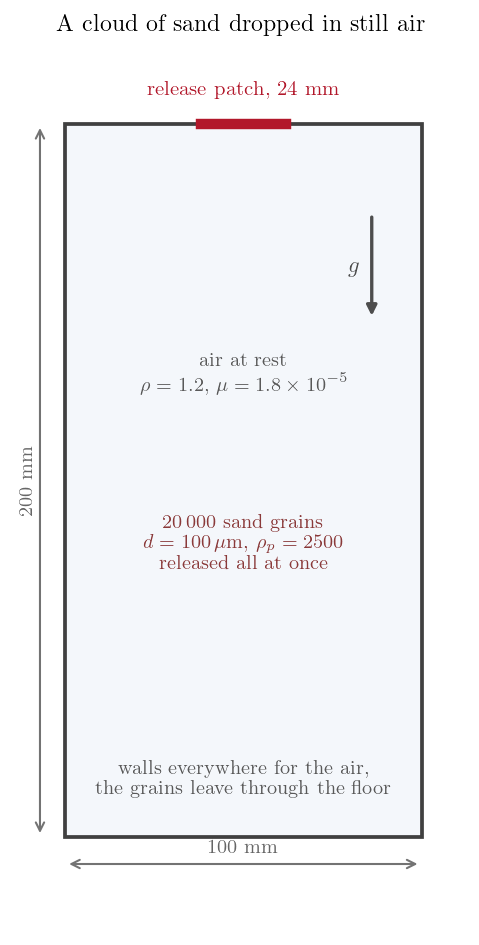
Figure 1: The grains are released together from the patch, fall under gravity,
and leave through the floor.
| Boundary | Fluid | Particles |
|---|---|---|
| release patch (top, centre) | wall | release |
| rest of the top, side walls | walls | rebound |
| floor | wall | outlet, the grains leave the computation |
| spanwise planes | symmetry | particle symmetry |
Every boundary is a wall for the air, so nothing can drive it and whatever motion appears has one possible origin. The grains, on the other hand, leave through the floor once they have crossed the box: they stop feeding momentum to the air at that point, and the flow they created outlives them.
Numerical setup
| Setting | Value |
|---|---|
| Mesh | \(60 \times 120 \times 1\) cells |
| Turbulence | \(k\)-\(\varepsilon\), required by the coupling |
| Time step | \(2\times10^{-4}\) s, constant |
| Iterations | \(3000\) |
The run is long enough for every grain to cross the box and leave.
Running the simulation
cd Lag_Twoway_Sand/

cd CASE_ONEWAY && code_saturne run --n 4 --id drop && cd ..
cd CASE_TWOWAY && code_saturne run --n 4 --id drop && cd ..
Each run takes a few minutes on four cores.
Results
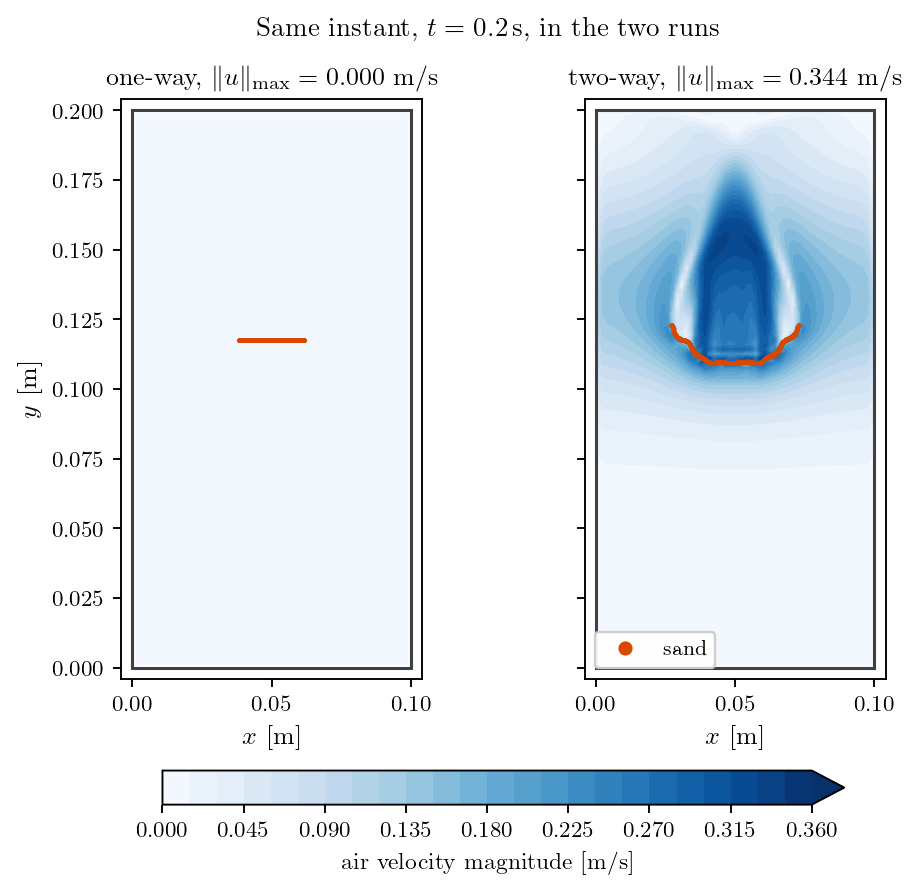
Figure 2: Air velocity and grains at the same instant in both runs. Left, the
grains fall and the air does not move. Right, the grains drive a plume and the
sheet bows into it.
The left panel matters as much as the right one. Its air is not slow, it is at rest to machine precision: in one-way coupling no amount of falling sand can move it, and the grains simply settle at their terminal velocity, in a sheet that stays perfectly flat.
Switch the coupling on and the sand becomes part of the flow problem. It drives a plume down the box, fed by a return flow along the walls, and the grains fall noticeably faster than they did alone, because they are riding the plume they created. The sheet shows it too: it bows downwards at its centre, where the plume is strongest, instead of staying flat.
The air also keeps turning over the box after the last grain has left. Momentum handed to the air stays there until viscosity and the walls take it back, which is something a one-way computation cannot represent at all.
Summary
One setting apart, two runs of the same closed box. One-way: air at rest, grains at their terminal velocity, sheet flat. Two-way: a plume driven by nothing but the grains, a sheet bowing into it, grains falling faster, and a flow that outlives the sand.
Two things to take away. The return coupling is unavailable without a turbulence model, and it is the particle mass, not the particle count, that decides whether any of this matters.
References
Authors
Simvia - Questions, remarks and requests are welcome.