Cross-flow Cooling Tower with Rain (ctwr)
A step-by-step tutorial exercising two further features of the cooling tower
module (ctwr) of code_saturne, on top of the counter-current base case
(Ctwr_Counterflow_Tower):
- a cross-flow exchange zone (
CS_CTWR_CROSS_CURRENT): the air flows horizontally while the water falls vertically through the packing, so the two streams cross; - a rain zone: a leakage factor turns part of the injected water into droplets that leak out of the packing and fall through the domain (the rain model).
Maintained by Simvia, part of the tutoriel-code_saturne collection.
Learning objectives
After completing this tutorial you will be able to:
- Define a cross-flow packing exchange zone with
cs_ctwr_define(CS_CTWR_CROSS_CURRENT). - Activate the rain model through a positive leakage factor and see the droplets fall below the packing.
- Read a cross-flow result: the air warms and humidifies along its path as it crosses the fill, while the water cools falling through it.
Prerequisites
| Requirement | Detail |
|---|---|
| code_saturne | v9.1 |
| Tutorials | Ctwr_Counterflow_Tower (the counter-current base case, read it first) |
If code_saturne is not yet installed, build it from the official homepage, pull a ready-to-use Singularity image from the Open Simulation Center, or pull the Simvia Docker image before continuing.
Case files
Ctwr_Crossflow_Rain/
├── CASE/
│   ├── DATA/setup.xml                    # GUI: ctwr model, k-epsilon, mesh, BCs, time
│   └── SRC/
│       ├── cs_user_parameters.cpp        # humid-air properties, evaporation model
│       ├── cs_user_zones.cpp             # cross-flow packing + rain (cs_ctwr_define)
│       ├── cs_user_boundary_conditions.cpp   # inlet values of the model variables
│       └── cs_user_initialization.cpp    # initial humid-air state
├── FIGURES/
└── README.md
As in the base case, the model, turbulence, mesh and standard boundary conditions are set through the GUI; only the packing exchange zone (built by
cs_ctwr_define), the detailed humid-air properties, the model-variable inlet values and the initial state are in C.
Physical model
The cooling tower physics is the one of the base case (humid air coupled to a liquid water field through an evaporation law, Poppe model). Two options change:
- Cross-flow exchange zone. The packing is declared with
CS_CTWR_CROSS_CURRENT: the air crosses it horizontally while the water falls vertically. Unlike the counter-current case, the air warms and humidifies along its horizontal path, hottest near the top of the fill where the water is injected. - Rain. The
cs_ctwr_defineleakage factor (\(15\%\) here) sends part of the injected water out of the packing as droplets. code_saturne then transports a rain field (mass fraction and temperature of the droplets), which falls under gravity below the packing.
Setup parameters
| Quantity | Value |
|---|---|
| Domain | \(4 \times 6\) m (2D slice), packing block \(1 \le x \le 3\), \(2 \le z \le 5\) |
| Air inlet (left) | \(1.5\) m/s horizontal, \(15\)°C, \(6\) g/kg |
| Injected water | \(36\)°C, cross-flow, \(15\%\) leakage to rain |
| Evaporation model | Poppe |
| Turbulence | \(k\)-\(\varepsilon\) |
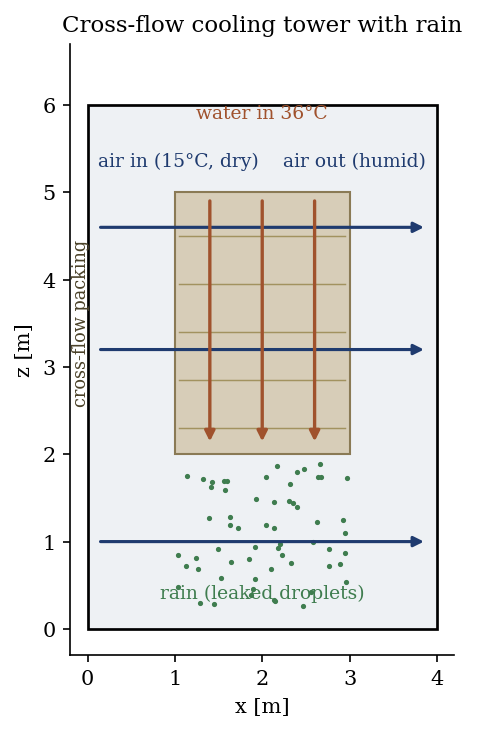
Figure 1: cross-flow tower. Air crosses the packing horizontally (blue), water falls through it (red), and a fraction leaks as rain (green droplets) below the fill.
Geometry and boundary conditions
A 2D slice, \(z\) the vertical, \(x\) the air-flow direction. The left face (X0) is
the air inlet (horizontal velocity, \(15\)°C), the right face (X1) is the outlet,
the top and bottom (Z0/Z1) are walls and the spanwise faces (Y0/Y1) are
symmetry. The packing occupies the block \(1 \le x \le 3\), \(2 \le z \le 5\).
Numerical setup
Same as the base case (cooling tower model selected in the GUI, dilatable
algorithm and humid-air properties in cs_user_parameters.cpp). The packing is
declared cross-current with a positive leakage factor in cs_user_zones.cpp. The
run advances to a near-steady state (\(3000\) steps).
Running the simulation
cd CASE
code_saturne run --n 4
Results
Cross-flow. The air warms as it crosses the packing from left to right, from \(15\)°C at the inlet to about \(17\)-\(18\)°C, hottest near the top of the fill where the \(36\)°C water enters. The horizontal gradient is the cross-flow signature (the counter-current case had a vertical one).
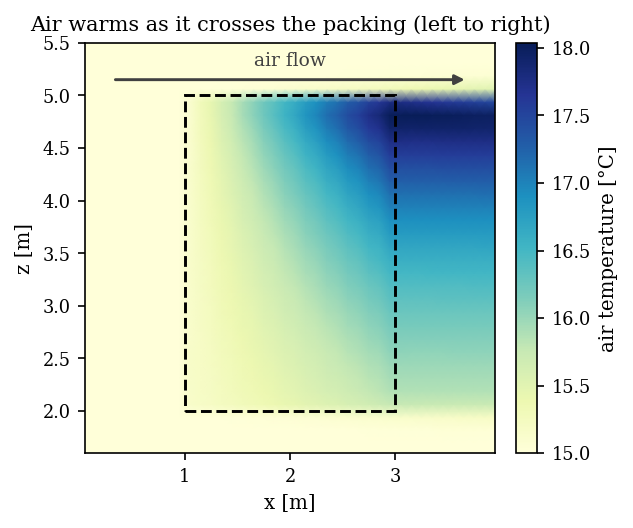
Figure 2: air temperature. The air warms along its path through the packing (dashed block), hottest near the top where the hot water enters.
Rain. The leaked droplets appear at the bottom of the packing and fall as a column below it, slightly carried downstream by the air. This rain field is transported by the module (mass fraction and temperature of the droplets).
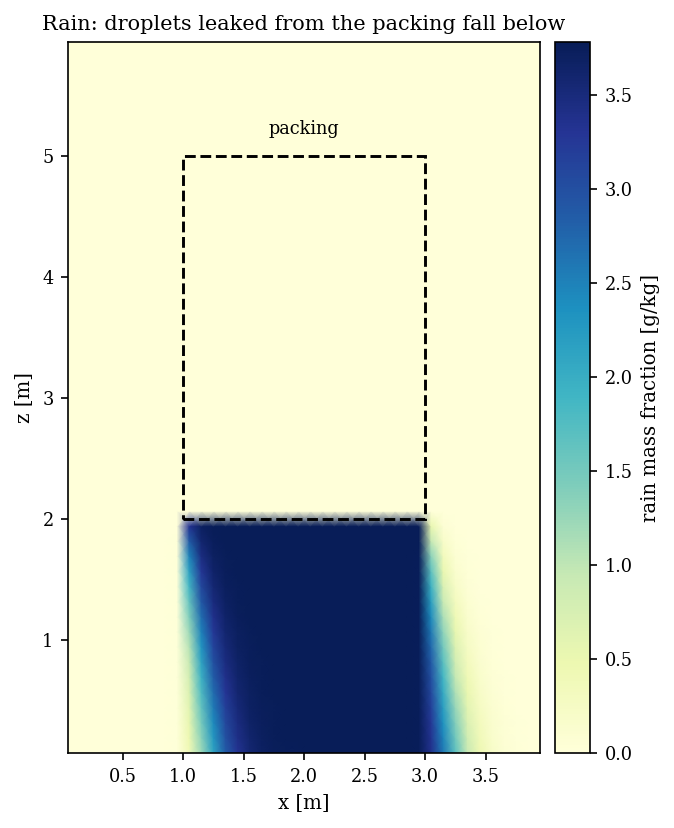
Figure 3: rain mass fraction. Droplets leak from the packing (dashed block) and fall below, the rain model triggered by the leakage factor.
This is a demonstration of the two features rather than a validated case; the rain here is dilute (its own heat exchange is small), its purpose is to show the droplet model being activated and transported.
Summary
This tutorial exercised two more cooling tower features: a cross-flow packing
(air horizontal, water vertical) and a rain zone (droplets leaked from the
packing). The air warms along its horizontal path through the fill and the leaked
water falls as rain below it. With the counter-current base case, the pair covers
the main configurations of the ctwr module: counter-current and cross-flow
packings, and the packing and rain exchange paths.
References
- M. Poppe, H. Rögener. Berechnung von Rückkühlwerken, VDI-Wärmeatlas, 1991.
- J. C. Kloppers, D. G. Kröger. A critical investigation into the heat and mass transfer analysis of counterflow wet-cooling towers, Int. J. Heat Mass Transfer 48, 765-777, 2005.
- code_saturne documentation
Authors
Simvia. Questions, remarks and requests are welcome.