Rayleigh Bubble Collapse (VOF Cavitation Model)
A step-by-step tutorial for simulating the collapse of a vapor bubble with the cavitation model of code_saturne: a spherical vapor bubble at rest in pressurized water implodes under the ambient overpressure. The case is the academic companion of Vof_Cavitating_Throttle: the throttle exercises the vaporization source term in a realistic device, this case exercises the condensation term in the simplest possible geometry, on a built-in Cartesian mesh with no mesh file at all. As a bonus, the classical Rayleigh solution (1917) provides a reference to quantify the result.
Maintained by Simvia, part of the tutoriel-code_saturne collection.
Learning objectives
After completing this tutorial you will be able to:
- Set up a bubble collapse with the VOF cavitation model (Merkle) on the built-in Cartesian mesher.
- Exploit spherical symmetry with an octant domain (three symmetry planes).
- Initialize the void fraction with a
cs_user_initialization.cppuser routine and set the mandatory cavitation parameters incs_user_parameters.cpp. - Post-process the bubble radius history and compare it with the Rayleigh solution.
Prerequisites
| Requirement | Detail |
|---|---|
| code_saturne | v9.1 |
| Case | Vof_Cavitating_Throttle (cavitation model basics and its mandatory user file) |
If code_saturne is not yet installed, build it from the official homepage, pull a ready-to-use Singularity image from the Open Simulation Center, or pull the Simvia Docker image before continuing.
Case files
Vof_Rayleigh_Collapse/
├── CASE/
│   ├── DATA/
│   │   └── setup.xml                    # pre-configured GUI case
│   └── SRC/
│       ├── cs_user_initialization.cpp   # spherical vapor bubble at rest
│       └── cs_user_parameters.cpp       # cavitation model parameters (MANDATORY)
├── FIGURES/                             # figures used in this README
└── README.md
There is no MESH directory: the mesh is generated at run time by the built-in cartesian mesher (\(48^3\) cells on the octant \([0, 4R_0]^3\)).
Physical model
A spherical vapor bubble of radius \(R_0\) rests in quiescent water whose far-field pressure \(p_\infty\) exceeds the vapor pressure \(p_{\mathrm{sat}}\): the bubble collapses. Neglecting viscosity, surface tension and gas content, the interface obeys the Rayleigh equation
whose solution reaches \(R = 0\) in the finite Rayleigh collapse time
for the present values (\(R_0 = 1\) mm, \(\Delta p = 98985\) Pa). The final stage concentrates the liquid inertia into a tiny volume, producing a violent pressure spike at the implosion point: this mechanism, which motivated Rayleigh's 1917 paper, is the root cause of cavitation erosion on ship propellers and pump impellers.
In code_saturne the bubble is handled by the VOF cavitation model (see the throttle tutorial for the equations): inside the bubble \(p < p_{\mathrm{sat}}\) is maintained by the vapor, the surrounding liquid is driven inward by the pressure gradient, and the condensation branch of the Merkle source term destroys the vapor as the interface sweeps in. The same two user files as the throttle are used: cs_user_parameters.cpp (mandatory model parameters, here \(u_\infty = \sqrt{\Delta p/\rho_l} \approx 10\ \mathrm{m/s}\) and \(\ell_\infty = R_0\)) and cs_user_initialization.cpp (a smoothed spherical void-fraction profile, fluid at rest).
Flow parameters
| Quantity | Symbol | Value | Source |
|---|---|---|---|
| Initial bubble radius | \(R_0\) | \(1\) mm | cs_user_initialization.cpp |
| Liquid (water, 20 °C) | \(\rho_l\), \(\mu_l\) | \(998\ \mathrm{kg\,m^{-3}}\), \(10^{-3}\ \mathrm{Pa\,s}\) | density, molecular_viscosity (value_0) |
| Vapor | \(\rho_v\), \(\mu_v\) | \(1\ \mathrm{kg\,m^{-3}}\), \(10^{-5}\ \mathrm{Pa\,s}\) | (value_1) |
| Far-field pressure | \(p_\infty\) | \(101325\) Pa | reference_pressure |
| Saturation pressure | \(p_{\mathrm{sat}}\) | \(2340\) Pa | cs_user_parameters.cpp |
| Driving pressure | \(\Delta p\) | \(98985\) Pa | derived |
| Rayleigh time | \(\tau\) | \(91.9\ \mathrm{\mu s}\) | derived |
| Domain (octant) | \([0, 4\ \mathrm{mm}]^3\), \(48^3\) cells | mesh_cartesian |
|
| Time step | \(\Delta t\) | \(2 \times 10^{-7}\) s (fixed) | time_step_ref |
| Simulated time | \(t_{end}\) | \(240\ \mathrm{\mu s}\) (\(1200\) steps) | iterations |
Geometry and boundary conditions
One octant of the bubble is computed: the three coordinate planes carry symmetry conditions, and the bubble center sits at the origin. The three far faces are free outlets holding the far-field pressure \(p_\infty\); they are \(4 R_0\) away from the center, which is sufficient here since the liquid inflow they must supply decays as \((R/r)^2\).
| Boundary | Location | Nature | Zone selector |
|---|---|---|---|
SymX, SymY, SymZ |
\(x=0\), \(y=0\), \(z=0\) | Symmetry | X0, Y0, Z0 |
Far |
far faces | Free outlet (\(p = p_\infty\)) | X1 or Y1 or Z1 |
With \(48^3\) cells the initial bubble radius spans 12 cells, and the interface is initialized with a \(\tanh\) profile about one cell thick.
Numerical setup
| Setting | Value | Rationale |
|---|---|---|
| Two-phase model | VOF + Merkle cavitation (merkle_model) |
Condensation drives the collapse |
| Velocity-pressure coupling | SIMPLEC | Standard segregated coupling |
| Velocity convection scheme | 1st-order upwind (blending_factor 0) |
Robustness |
| Time-stepping | Fixed \(\Delta t = 2 \times 10^{-7}\) s (\(\tau/460\)) | Resolves the collapse acceleration |
| Turbulence | none (laminar) | Radial laminar flow |
| Output | EnSight every 20 steps | \(\approx 23\) frames over the collapse |
| Probe | bubble center | Pressure and void fraction monitoring |
Running the simulation
The commands below start from the tutorial directory:
cd Vof_Rayleigh_Collapse/
Option A: Graphical interface
code_saturne gui CASE/DATA/setup.xml &
The GUI opens the pre-configured setup.xml. Review the setup if you wish,
then launch the run with the gear (Run) button in the toolbar.
Option B: Command line
The command-line launcher is run from inside the case directory:
cd CASE

# serial
code_saturne run

# parallel (e.g. 4 MPI ranks)
code_saturne run --n 4
The two user routines are compiled automatically at the beginning of the run. The case takes a few minutes on 4 cores.
Results
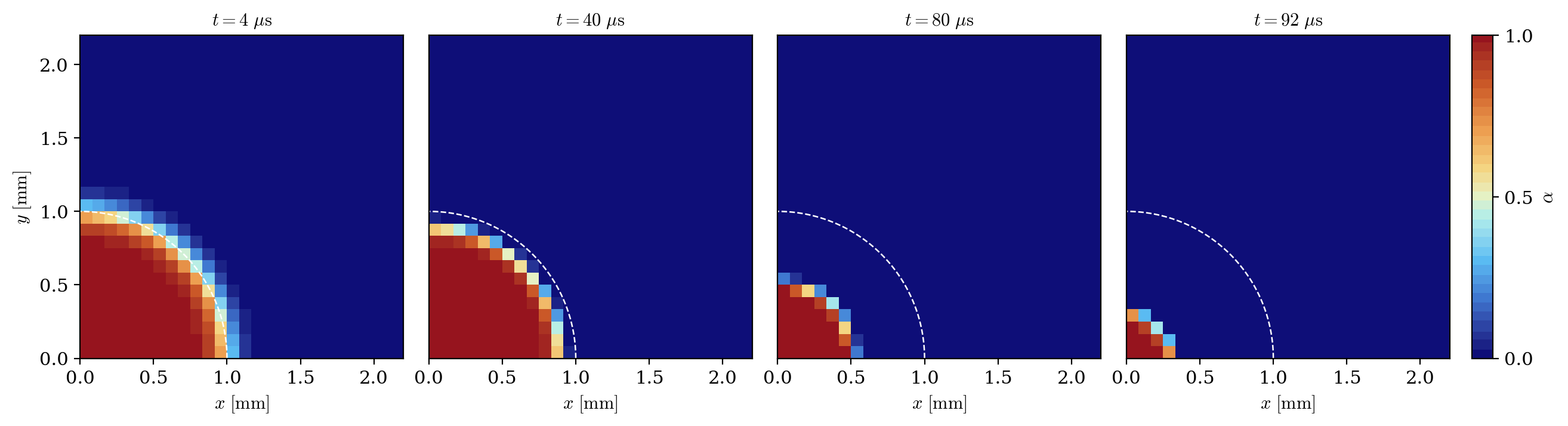
Figure 1: void fraction in the $z \approx 0$ cell layer at $t = 4$, $40$, $80$ and $92\ \mathrm{\mu s}$ (the dashed quarter-circle marks $R_0$). The bubble stays spherical while it shrinks, and the collapse accelerates: half of the radius is lost in the last quarter of the collapse time.
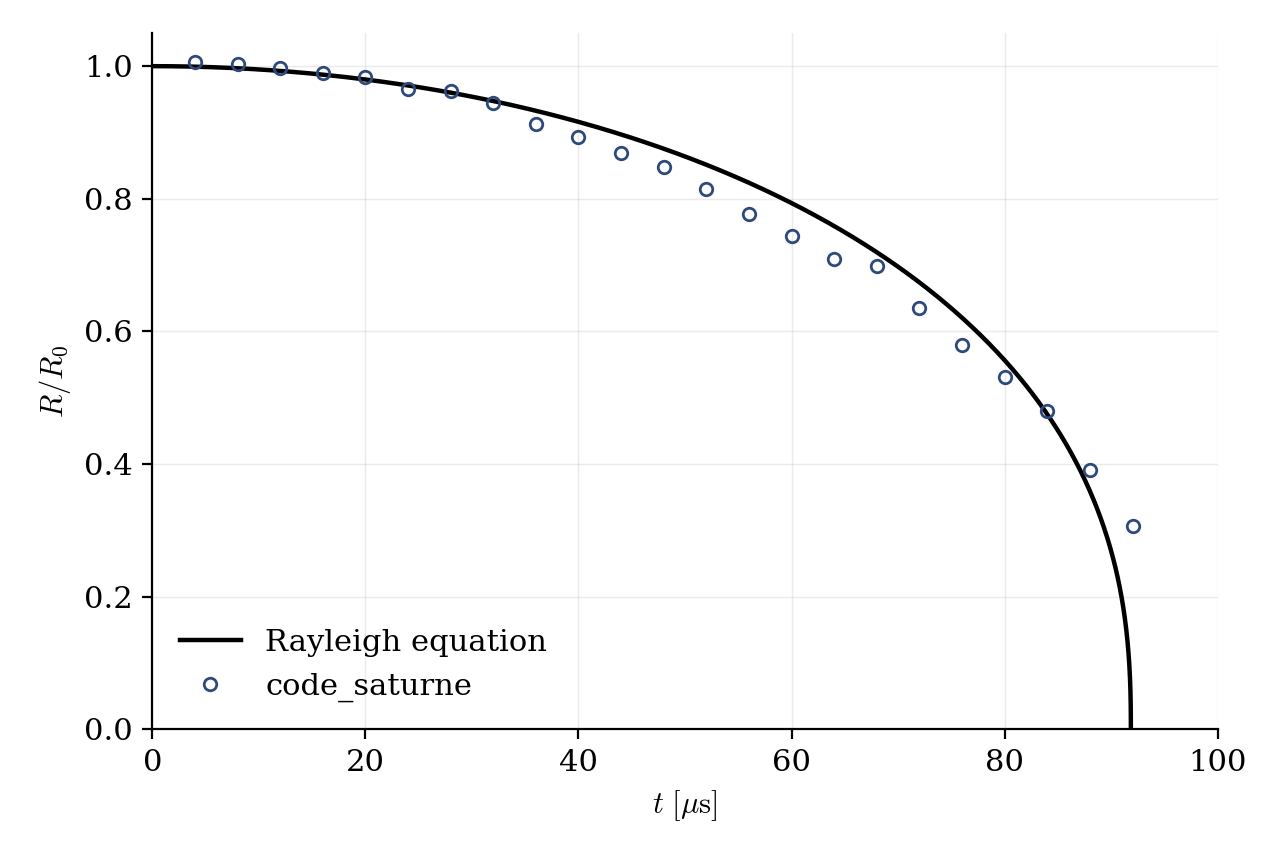
Figure 2: equivalent bubble radius $R(t) = (3V_{vap}/4\pi)^{1/3}$ (symbols, shown while the bubble remains resolved by the mesh, i.e. $R \gtrsim 3$ cells) against the integrated Rayleigh equation (line).
The computed radius follows the Rayleigh law throughout the resolved phase of the collapse; the small deviations are largely attributable to the deliberately modest mesh used in this tutorial (\(48^3\), i.e. 12 cells on the initial radius, with an interface smeared over a few cells). The very last stage (\(R\) below a few cells) is not shown: no mesh resolves a collapse to a point, and the residual sub-cell vapor is not physics.
Summary
This tutorial set up the collapse of a spherical vapor bubble with the cavitation model of code_saturne: an octant domain on the built-in Cartesian mesher, a void-fraction sphere initialized by a user routine, and the mandatory cavitation parameters file. The computed radius history follows the Rayleigh solution closely, which quantifies the quality of the result. Together with Vof_Cavitating_Throttle, it covers both directions of the Merkle mass transfer: vaporization in the throttle, condensation here.
References
- Lord Rayleigh. On the pressure developed in a liquid during the collapse of a spherical cavity, Phil. Mag., 34:94-98, 1917.
- J.P. Franc, J.M. Michel. Fundamentals of Cavitation, Kluwer, 2004.
- code_saturne documentation
Authors
Simvia - Questions, remarks and requests are welcome.