Mesh Replication (One Pattern, Read N Times)
A step-by-step tutorial for the mesh input transformations of code_saturne: reading the same mesh file several times, each instance with its own translation and group renames, to assemble a domain from a repeated pattern. This is the industrial reflex for periodic equipment (tube banks, heat-exchanger passes, fuel assemblies): mesh the pattern once, replicate it at run time. Here a single "tube in a channel segment" pattern becomes a three-tube bank: one .msh, three instances, two joinings.
Maintained by Simvia, part of the tutoriel-code_saturne collection.
Learning objectives
After completing this tutorial you will be able to:
- Read a mesh file several times with
cs_preprocessor_data_add_file(cs_user_mesh_input): homogeneous transformation matrix, and group renames per instance. - Combine the replication with face joinings to glue the instances into one domain (Pre_Face_Joining is the prerequisite skill).
- Check the assembly in the log: the file read N times, the renamed zones, the merged shared groups.
Prerequisites
| Requirement | Detail |
|---|---|
| code_saturne | v9.1 |
| Tutorial | Pre_Face_Joining (face joining, reading the preprocessing report) |
| gmsh | only to regenerate the pattern (the .geo source and .msh are shipped) |
If code_saturne is not yet installed, build it from the official homepage, pull a ready-to-use Singularity image from the Open Simulation Center, or pull the Simvia Docker image before continuing.
Case files
Pre_Mesh_Replication/
├── CASE/
│   ├── DATA/setup.xml       # pattern listed ONCE + the two joinings
│   └── SRC/cs_user_mesh.cpp # three reads, translated and renamed
├── MESH/
│   └── tube_pattern.geo/.msh  # THE pattern: one tube in a channel segment
├── FIGURES/                 # figures used in this README
└── README.md
The case
The pattern is a \(0.1 \times 0.1\) m channel segment crossed by a tube (\(D = 30\) mm), meshed once (unstructured quadrangles, refined on the tube, \(2\,007\) cells) with groups Left, Right, Walls, Tube, Sym. The assembly plays in two places:
The staging trick. The GUI lists tube_pattern.msh once, as any case would: the staging step converts it to mesh_input.csm in the execution directory. The routine then replaces this default input: the first cs_preprocessor_data_add_file call overrides it, the following ones append. Each call reads the same mesh_input.csm with its own transformation (translations of \(0\), \(0.1\), \(0.2\) m) and its own renames:
| Instance | Left becomes |
Right becomes |
|---|---|---|
| 1 | Inlet |
R1 |
| 2 | L2 |
R2 |
| 3 | L3 |
Outlet |
Groups that are not renamed (Walls, Tube, Sym) keep their name in every instance and merge into single zones: one wall boundary condition covers the three tubes.
The gluing. The internal interfaces are joined by two face joinings defined in the GUI (R1 or L2 and R2 or L3), exactly as in Pre_Face_Joining: here the two sides even match node for node (same mesh, translated), the easy case.
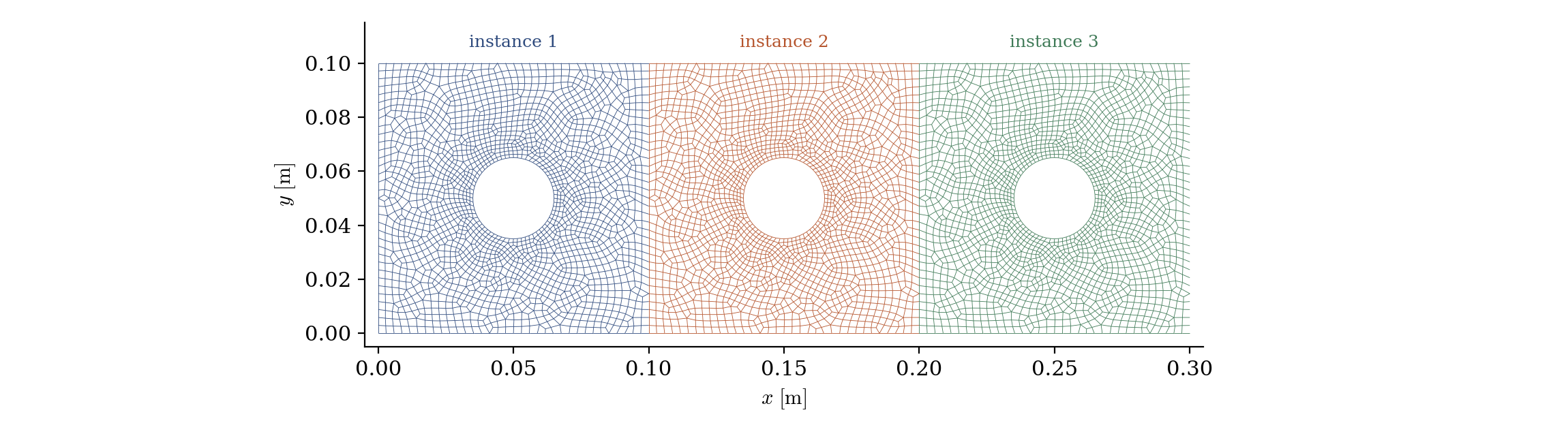
Figure 1: the assembled mesh, one color per instance: the same 2007-cell pattern, read three times.
The log carries the whole story: Reading file: mesh_input.csm printed three times, the assembled mesh at \(3 \times 2\,007 = 6\,021\) cells, the boundary-zone list showing Inlet and Outlet (\(34\) faces each), the merged Tube zone (\(192\) faces, three tubes), and no R1/L2/R2/L3 zones left after the joinings.
Running the simulation
The commands below start from the tutorial directory:
cd Pre_Mesh_Replication/
The support flow is laminar (\(Re_D = 30\) on the tube, uniform inlet at \(U_b = 0.1\) m/s). Run (GUI: open setup.xml and use the Run button; the routine in SRC/ is compiled automatically):
cd CASE
code_saturne run --id replication
Results
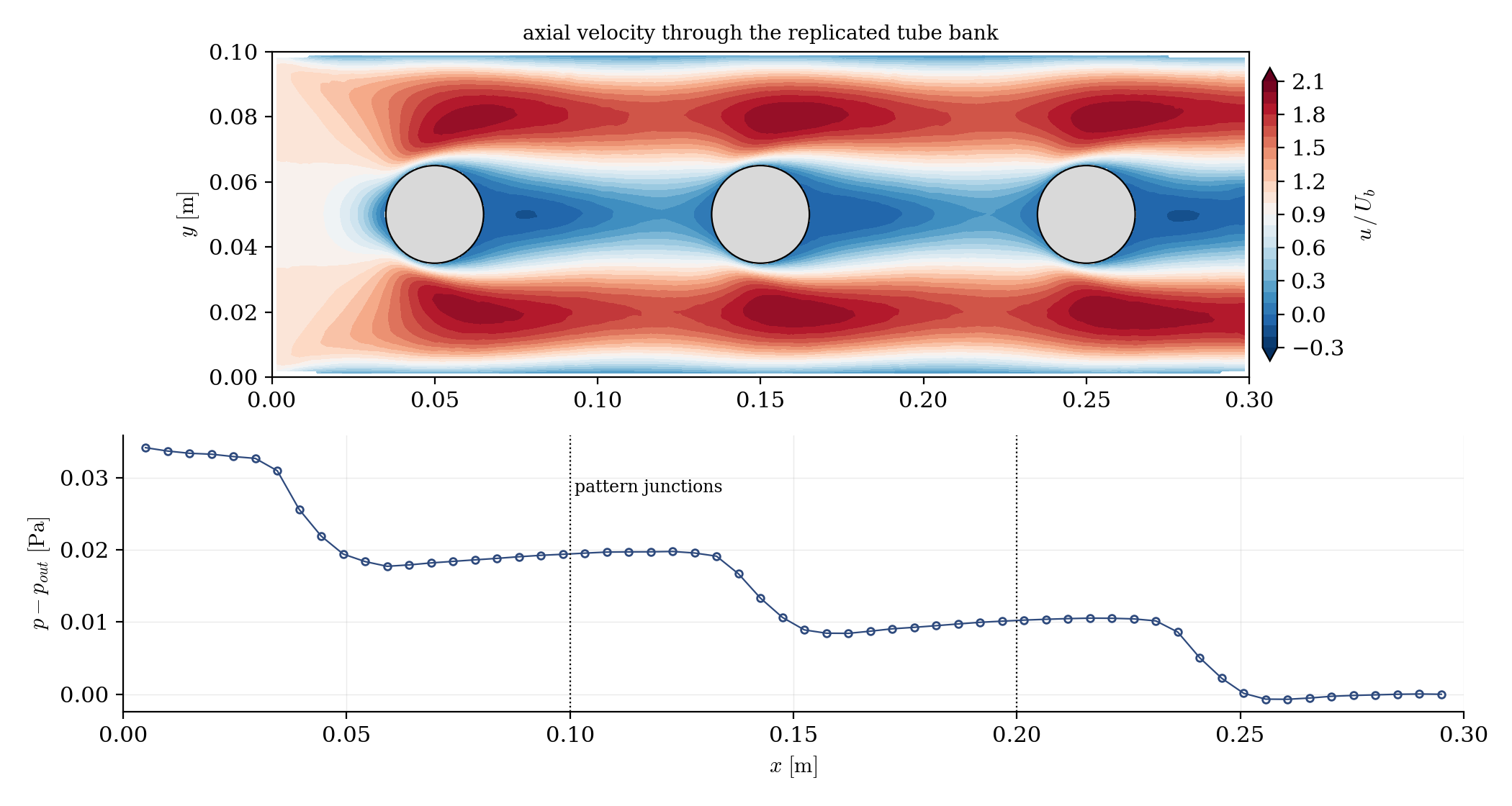
Figure 2: top, axial velocity through the bank: the flow accelerates to about twice the inlet velocity in the passages (the tube blocks $30\%$ of the height) and leaves a weak steady wake behind each tube; bottom, section-averaged pressure: a staircase with one drop per tube and plateaus in between.
The flow reads like the assembly: the same jet-and-wake structure repeats behind each tube, and the pressure falls in three steps, one per pattern. The second and third patterns, which receive similar incoming profiles, drop nearly the same pressure (within about \(5\%\)); the first one pays in addition the development of the uniform inlet profile. Mass is conserved through the whole bank.
Summary
This tutorial assembled a three-tube bank from a single pattern mesh: the GUI lists the pattern once, and a short cs_user_mesh_input routine reads the staged mesh_input.csm three times, each instance translated and its side groups renamed; two GUI face joinings glue the interfaces, and the unrenamed groups merge into shared zones. Mesh the pattern once, replicate at run time: the mesh file stays as small as its pattern, and changing the number of instances is a loop bound.
References
Authors
Simvia - Questions, remarks and requests are welcome.