Sorption Retardation of a Groundwater Tracer (CDO)
A step-by-step tutorial for reactive transport in the groundwater flow (GWF) module of code_saturne: the same saturated Darcy flow as Gwf_Darcy_Tracer, but now the tracer adsorbs onto the soil. The showcased feature is linear equilibrium sorption: two tracers are injected side by side, one conservative (no sorption) and one sorbing, and the sorbing front is retarded by the factor \(R = 1 + \rho_b\,k_d/\theta_s\). The case is validated against the retarded Ogata-Banks solution.
Maintained by Simvia, part of the tutoriel-code_saturne collection.
Learning objectives
After completing this tutorial you will be able to:
- Add several tracers to one groundwater calculation and give each its own transport parameters.
- Activate linear sorption through the distribution coefficient \(k_d\) and understand the resulting retardation factor \(R\).
- Read the retardation directly from the front positions (a sorbing plume lags a conservative one by \(R\)).
- Validate both fronts against the retarded Ogata-Banks solution.
Prerequisites
| Requirement | Detail |
|---|---|
| code_saturne | v9.1 (built with the CDO module, default) |
| Tutorials | Gwf_Darcy_Tracer (the saturated Darcy + tracer base case, read it first) |
If code_saturne is not yet installed, build it from the official homepage, pull a ready-to-use Singularity image from the Open Simulation Center, or pull the Simvia Docker image before continuing.
Case files
Gwf_Sorption_Retardation/
├── CASE/
│   ├── DATA/setup.xml               # mesh, time stepping, output (as Gwf_Darcy_Tracer)
│   └── SRC/
│       ├── cs_user_zones.cpp        # volume + inlet/outlet boundary zones
│       └── cs_user_parameters.cpp   # GWF model, soil, TWO tracers, BCs
├── FIGURES/
└── README.md
No mesh file: the 2D soil block is built by the built-in cartesian mesher. The flow setup is identical to Gwf_Darcy_Tracer; the only change is a second tracer and a non-zero distribution coefficient.
Physical model
The flow is unchanged from the base case: a saturated soil with a uniform hydraulic conductivity \(K\), driven by two imposed hydraulic heads, gives a linear head and a uniform Darcy flux \(\mathbf{q} = -K\,\nabla h\).
A tracer subject to linear equilibrium sorption partitions between the dissolved phase and the solid grains, \(s = k_d\,C\). Its transport equation gains an accumulation term on the solid:
with \(\rho_b\) the soil bulk density and \(k_d\) the distribution coefficient. Dividing by \(\theta_s + \rho_b k_d\) shows that both the advection and the dispersion are slowed by the retardation factor
The sorbing front therefore travels at \(v/R\) (with \(v = q/\theta_s\) the pore velocity) and spreads as \(\sqrt{D_L t / R}\). A conservative tracer (\(k_d = 0\), \(R = 1\)) is transported in the same run for comparison.
Flow and transport parameters
| Quantity | Symbol | Value |
|---|---|---|
| Domain | \(L \times H\) | \(100 \times 20\) m |
| Hydraulic conductivity | \(K\) | \(10^{-4}\) m/s |
| Porosity | \(\theta_s\) | \(0.4\) |
| Bulk density | \(\rho_b\) | \(2000\) kg/m³ |
| Pore velocity | \(v = q/\theta_s\) | \(2.5\times10^{-6}\) m/s |
| Longitudinal dispersivity | \(\alpha_L\) | \(1\) m |
| Distribution coefficient (sorbing) | \(k_d\) | \(2\times10^{-4}\) m³/kg |
| Retardation factor (sorbing) | \(R\) | \(2\) |
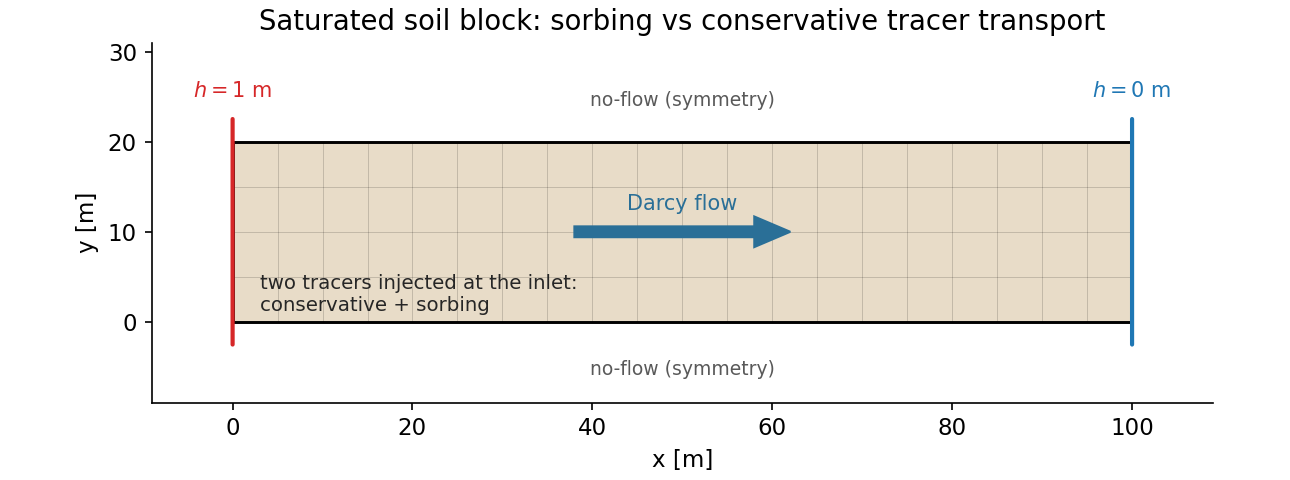
Figure 1: geometry, mesh and boundary conditions. Two tracers are injected at the inlet; only the distribution coefficient differs between them.
Geometry and boundary conditions
The soil block and flow BCs are those of the base case: \(h = 1\) m at the inlet
(left, group X0), \(h = 0\) m at the outlet (right, X1), no-flow top and
bottom. Both tracers are injected at \(C = 1\) at the inlet; the domain starts
tracer-free.
Numerical setup
Identical to Gwf_Darcy_Tracer: saturated single-phase
CDO model, steady Richards equation, unsteady tracer equations, \(\Delta t = 10^5\) s
for \(200\) steps (\(2\times10^7\) s). The two tracers are declared in
cs_user_parameters.cpp with cs_gwf_add_tracer, and their sorption is set by
the last argument of cs_gwf_tracer_set_soil_param (\(k_d = 0\) for the
conservative tracer, \(k_d = 2\times10^{-4}\) for the sorbing one).
Running the simulation
cd CASE
code_saturne run --n 4
The mesh is generated internally. The run writes CASE/RESU/<id>/ with the
hydraulic head, the two tracer concentrations Cc (conservative) and Cs
(sorbing), and the Darcy flux in postprocessing/.
Results and verification
Concentration profiles. At the final time the conservative front has reached \(x \approx 51\) m (pore velocity \(v\,t = 50\) m), while the sorbing front is only at \(x \approx 26\) m: exactly half, the signature of \(R = 2\). Both fronts lie on their retarded Ogata-Banks curves,
with \(R = 1\) and \(R = 2\) respectively.
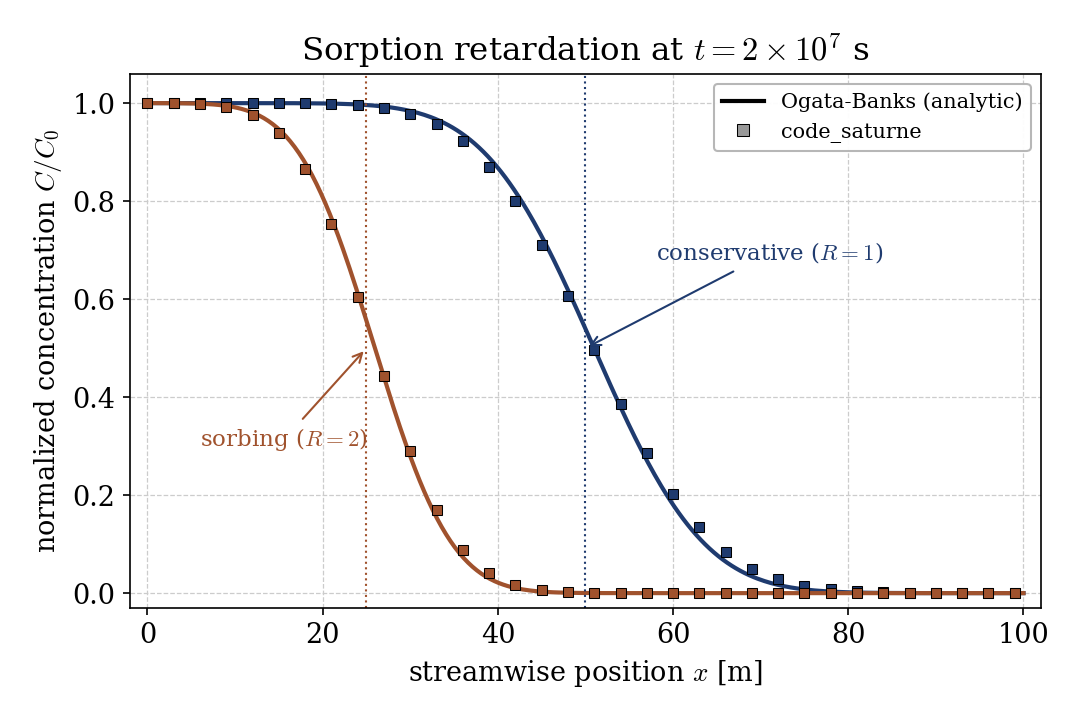
Figure 2: conservative and sorbing fronts at $t = 2\times10^{7}$ s (symbols) versus the retarded Ogata-Banks solution (lines). The sorbing plume lags by the factor $R$.
Front position in time. Tracking the \(C = 0.5\) crossing of each tracer gives two straight lines through the origin, of slope \(v\) and \(v/R\). The computed front positions fall on the analytic lines at every output time, a direct measurement of the retardation factor (\(R = 2\), the sorbing slope is half).
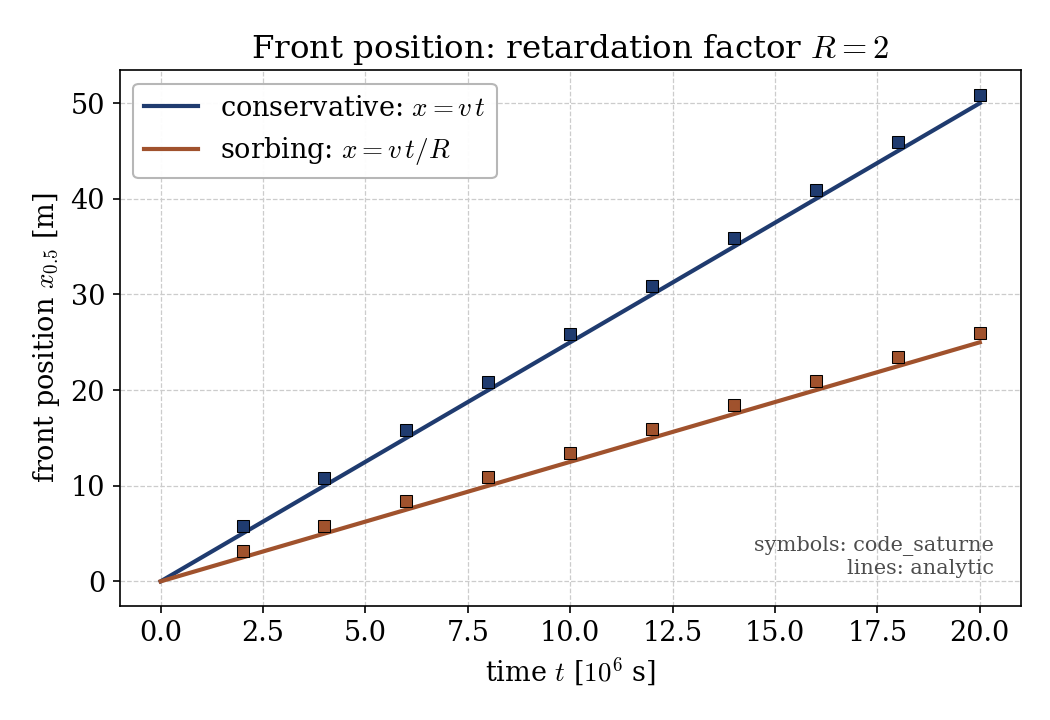
Figure 3: front position versus time. The ratio of slopes is the retardation factor $R = 2$.
Summary
This tutorial added linear equilibrium sorption to the saturated groundwater tracer transport of the base case. Two tracers were carried in a single run: a conservative one and a sorbing one, differing only by the distribution coefficient \(k_d\). The sorbing front is retarded by \(R = 1 + \rho_b k_d/\theta_s = 2\), and both fronts match the retarded Ogata-Banks solution, in the concentration profiles and in the front-position history. The lesson that carries beyond this case: sorption does not change the flow, it rescales the transport, slowing a reactive plume relative to a conservative one by a factor that a groundwater model captures through a single soil parameter.
References
- A. Ogata, R. B. Banks. A solution of the differential equation of longitudinal dispersion in porous media, U.S. Geological Survey Professional Paper 411-A, 1961.
- C. W. Fetter. Contaminant Hydrogeology, 2nd ed., Prentice Hall, 1999.
- code_saturne documentation
Authors
Simvia. Questions, remarks and requests are welcome.