Gas Diffusion Flame (cogz, 3-point chemistry)
A step-by-step tutorial on the gas combustion module (cogz) of
code_saturne, using the 3-point fast-chemistry diffusion flame model
(d3p, a Burke-Schumann description). A central propane jet burns in an
air co-flow: the flame anchors on its own at the surface where fuel and air
meet in stoichiometric proportion, no ignition source needed.
Maintained by Simvia, part of the tutoriel-code_saturne collection.
Learning objectives
After completing this tutorial you will be able to:
- Activate the gas combustion module and the 3-point diffusion flame
model (
d3p) entirely through the GUI. - Provide a thermochemistry data file (
dp_C3P, propane-air) and declare fuel and oxidizer inlets. - Read a diffusion flame result: the mixture fraction field (fuel/air mixing) and the temperature field (two flame sheets), and recognise the Burke-Schumann structure (temperature and products peak at the stoichiometric surface).
Prerequisites
| Requirement | Detail |
|---|---|
| code_saturne | v9.0.0 (see the note below) |
| Tutorials | any of the incompressible RANS cases (k-epsilon, inlets/outlets) |
Version note. This case is set up and validated on code_saturne 9.0.0. The
d3pmodel has a temperature-reconstruction regression in 9.1.0: on 9.1 the mean-temperature output blows up to a fixed, unphysical value (~42698 K) in the unburnt pure-fuel core (the internal density and flow stay bounded, so it is an output-only artifact, but it makes the temperature field unusable). Running the identicalsetup.xmlon both solvers gives a clean 300-1500 K field on 9.0.0 and the artifact on 9.1.0, so the difference is the solver version, not the setup. We therefore ship this tutorial as a 9.0.0 case until a fixed release is available. The Simvia code_saturne 9.0.0 Docker image reproduces it directly.
Case files
Cogz_Diffusion_Flame/
├── CASE/
│   └── DATA/
│       ├── setup.xml      # GUI: d3p model, radiation, mesh, inlets, walls, time
│       └── dp_C3P         # propane-air thermochemistry (shipped with the case)
├── FIGURES/
└── README.md
The whole case is built in the GUI: combustion model, thermochemistry file, turbulence, radiation, mesh, boundary conditions and time stepping. There are no user C routines.
dp_C3Pis a standard code_saturne reference thermochemistry file (found underdata/user/of the source tree), copied intoDATA/so the case is self-contained.
Physical model
The d3p model treats a non-premixed (diffusion) flame with infinitely
fast chemistry. Fuel and oxidizer are supplied by separate streams and mix by
turbulent transport. A single conserved scalar, the mixture fraction f
(f = 1 in the fuel stream, f = 0 in the air stream), together with its
variance describes the mixing; the chemistry is assumed instantaneous, so fuel
and oxygen cannot coexist. Temperature and composition are then functions of the
mixture fraction (the Burke-Schumann relation): they peak at the
stoichiometric surface and fall back to the inlet temperature in both pure
streams. No ignition or reaction-rate model is required.
Here the flame is non-adiabatic: the transported enthalpy (extended
option) is coupled to a P-1 radiation model, so the hot gas loses heat by
radiation to the (gray) walls. Chemistry is set by the dp_C3P file: propane
(C3H8) as fuel, air (O2 + 3.76 N2) as oxidizer, with CO2/H2O/N2 products.
Flow parameters
| Quantity | Value |
|---|---|
| Domain | \(0.15 \times 0.60\) m (2D slice, \(x\) across, \(z\) up) |
| Mesh | \(60 \times 120\) cells (cartesian) |
| Fuel jet (centre, width 2 cm) | propane, \(1.0\) m/s, \(300\) K |
| Air co-flow (either side) | air, \(0.5\) m/s, \(300\) K |
| Combustion model | d3p, extended (non-adiabatic) |
| Radiation | P-1, gray walls (\(\varepsilon = 0.8\)) |
| Turbulence | \(k\)-\(\varepsilon\) |
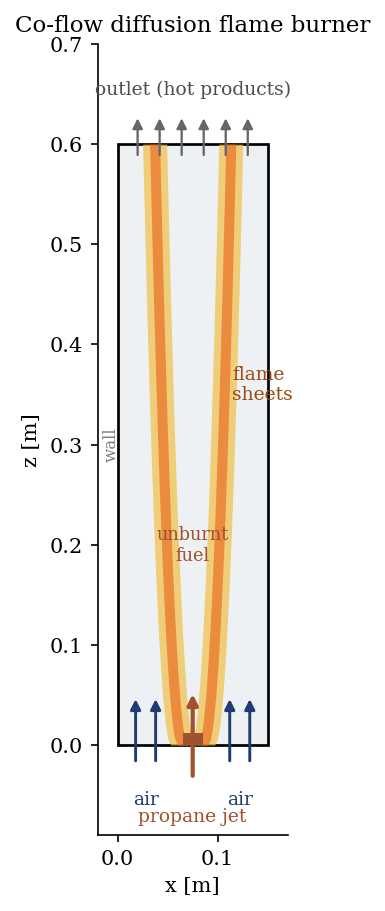
Figure 1: co-flow diffusion flame burner. Propane enters as a central jet
(rust), air as a co-flow (blue). Two flame sheets anchor at the jet rim and
open outward downstream; unburnt fuel stays in the core.
Geometry and boundary conditions
A 2D slice with \(z\) vertical (flow up) and \(x\) across. The bottom face is split
into a central fuel inlet (Z0 with \(0.065 < x < 0.085\), gas type fuel)
and an air inlet (the rest of Z0, gas type oxydant). The top (Z1) is a
free outlet, the sides (X0/X1) are gray radiative walls, and the
spanwise faces (Y0/Y1) are symmetry. The fuel/oxidizer inlet types are a
GUI setting (they set the mixture fraction to 1 and 0 respectively); the fuel and
oxidizer inlet temperatures (\(300\) K) are the reference fuel/oxidant
temperatures.
Numerical setup
Everything is selected in the GUI: the d3p combustion model with the dp_C3P
data file, the P-1 radiation model with gray walls, a \(k\)-\(\varepsilon\)
turbulence model, a cartesian mesh and the inlet/outlet/wall/symmetry zones. The
run advances to a near-steady state (\(2500\) time steps, \(\Delta t = 2\times
10^{-3}\) s).
Running the simulation
cd CASE
# with the Simvia 9.0.0 Docker image (see the version note above):
docker run --rm -v "$(pwd)":/home/code_saturne \
       simvia/code_saturne:9.0.0 run --n 4
Each run writes a timestamped CASE/RESU/<id>/ with run_solver.log and the
EnSight Gold output under postprocessing/.
Results and verification
Two flame sheets. The mixture fraction shows the propane jet mixing outward into the air; the temperature shows two flame sheets on either side of the jet, exactly where fuel meets air at the stoichiometric surface. The centre (pure fuel) and the outer region (pure air) stay cool, the classic signature of a non-premixed flame. The sheets open outward and merge downstream.
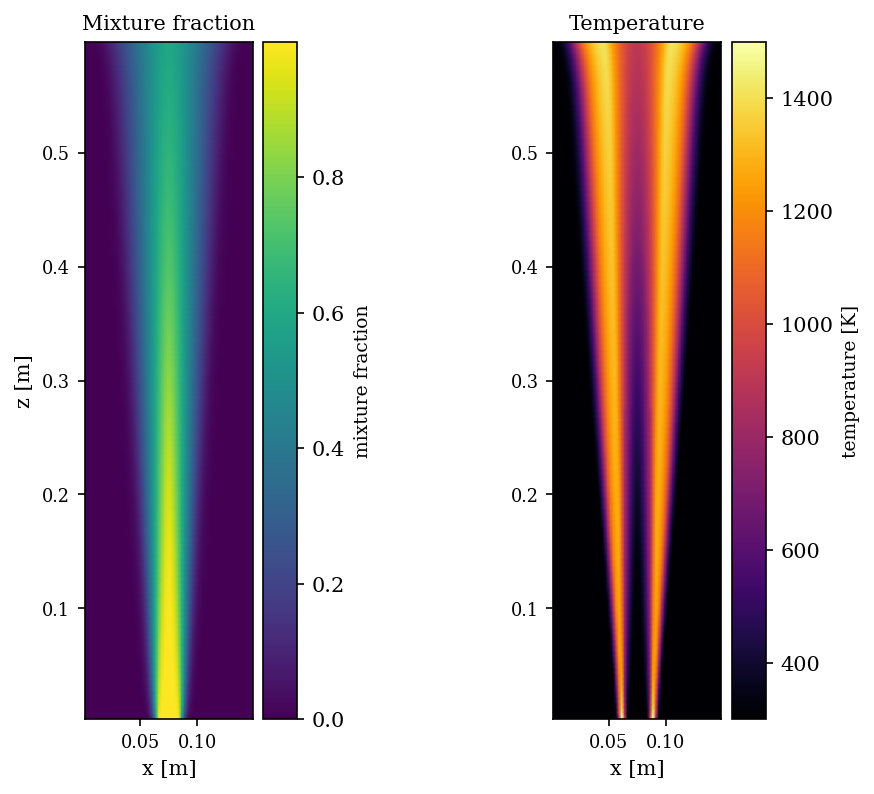
Figure 2: mixture fraction (left) and temperature (right). The flame sits
at the fuel/air interface, not in the pure-fuel core.
Burke-Schumann structure. Plotting the conditional means against the mixture fraction recovers the expected picture: oxidizer is consumed and products and temperature peak at the stoichiometric surface, then temperature falls back toward the inlet value in both the fuel-rich and air-rich limits. Fuel mass fraction rises linearly toward the pure-fuel stream.
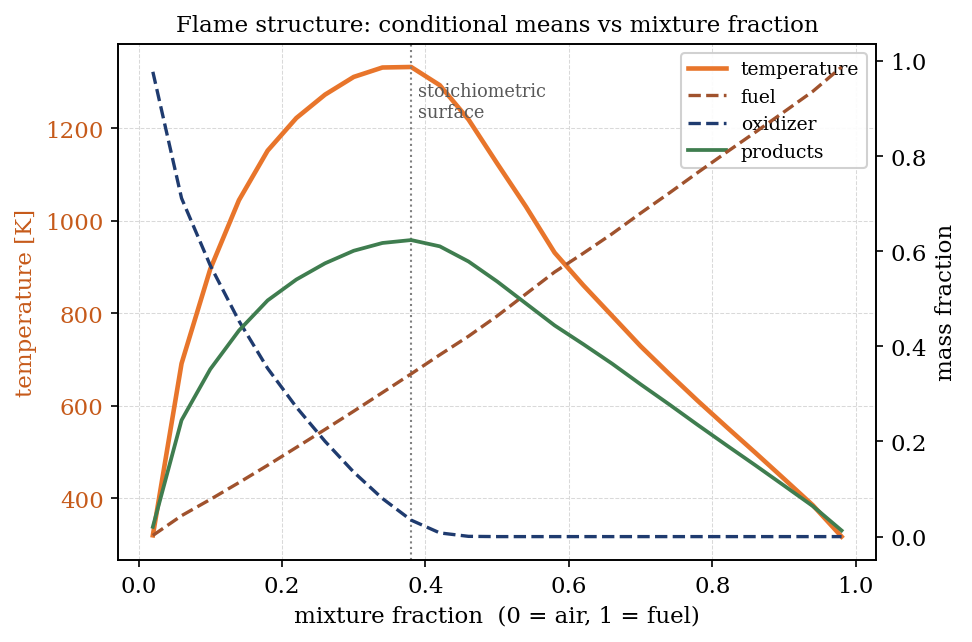
Figure 3: flame structure. Conditional-mean temperature and species vs
mixture fraction, the Burke-Schumann signature of a diffusion flame.
The peak mean temperature is about \(1500\) K. This is a turbulent, radiatively cooled mean: it is lower than the adiabatic stoichiometric flame temperature of propane-air (about \(2270\) K) because the \(k\)-\(\varepsilon\) mixture-fraction variance broadens the burning across a range of mixtures and the P-1 model removes heat by radiation. This is a demonstration of the diffusion flame model (structure, flame position, mixture-fraction coupling) rather than a quantitative flame-temperature validation.
Summary
This tutorial activated the cogz gas combustion module with the 3-point
diffusion flame model, entirely from the GUI: a propane jet in an air co-flow,
a shipped dp_C3P thermochemistry file, fuel/oxidizer inlets, and a
non-adiabatic (radiation-coupled) energy balance. The result is a textbook
co-flow diffusion flame: two flame sheets at the stoichiometric surface, a cool
unburnt-fuel core, and the Burke-Schumann coupling between temperature,
composition and mixture fraction.
References
- N. Peters. Turbulent Combustion, Cambridge University Press, 2000.
- S. B. Pope. Turbulent Flows, Cambridge University Press, 2000 (mixture fraction and non-premixed combustion).
- code_saturne documentation
Authors
Simvia. Questions, remarks and requests are welcome.