Sedov Blast Wave (cylindrical)
A step-by-step tutorial for simulating a Sedov blast wave with the compressible module of code_saturne: a finite amount of energy released at a point in a uniform gas at rest drives a self-similar shock wave. The computed shock trajectory is validated against the Sedov similarity law \(R(t) \propto t^{1/2}\), and the total energy conservation is verified.
Maintained by Simvia, part of the tutoriel-code_saturne collection.
Learning objectives
After completing this tutorial you will be able to:
- Override the GUI initialization with a
cs_user_initialization.cppuser routine (localized energy deposit). - Exploit the problem symmetry: quarter-plane domain with symmetry planes on the blast axes.
- Use supersonic outlet boundary conditions of the compressible module.
- Run a strongly transient computation with a CFL-controlled variable time step.
- Validate a computation against a self-similarity law (shock radius exponent and prefactor).
Prerequisites
| Requirement | Detail |
|---|---|
| code_saturne | v9.1 |
| Background | Gas dynamics; the Comp_Sod_Tube tutorial is the natural first step |
If code_saturne is not yet installed, build it from the official homepage, pull a ready-to-use Singularity image from the Open Simulation Center, or pull the Simvia Docker image before continuing.
Case files
Comp_Sedov_Blast_Wave/
├── CASE/
│   ├── DATA/
│   │   └── setup.xml                    # pre-configured GUI case
│   └── SRC/
│       └── cs_user_initialization.cpp   # energy deposit (overrides GUI init)
├── FIGURES/                             # figures used in this README
└── README.md
As for the Sod tube, there is no MESH directory: the mesh is generated at run time by the built-in cartesian mesher (\(200 \times 200 \times 1\) cells on \([0, 0.2]^2\)).
Physical model
The flow is governed by the Euler equations for a perfect gas with \(\gamma = 1.4\) (see the Comp_Sod_Tube tutorial for the equation set), solved with the compressible module in the inviscid limit: the viscosities and the conductivity are set exactly to zero through GUI user laws (see the Comp_Sod_Tube tutorial for details on this trick).
The Sedov problem: at \(t = 0\), an energy \(E'\) is deposited at the origin of a uniform gas at rest (\(\rho_0 = 1\), \(p_\infty = 0.01\)). The energy deposit is modeled by a small high-pressure disc, set by the user routine (which overrides the uniform GUI initialization):
(\(E'\) is the energy per unit length of the full cylindrical blast; the computation covers a quarter of it.)
Since the only parameters are \(E'\), \(\rho_0\) and \(t\), dimensional analysis imposes the self-similar propagation law of the shock. In this 2D planar computation the blast is cylindrical, hence:
with \(\xi\) a constant of order one depending on \(\gamma\) (Sedov, 1959). A spherical blast would give the famous \(t^{2/5}\) instead. Behind the shock, the strong-shock density jump is bounded by \((\gamma+1)/(\gamma-1) = 6\), and the core of the blast empties almost completely.
Flow parameters
| Quantity | Symbol | Value | Source in setup.xml / SRC |
|---|---|---|---|
| Heat capacity ratio | \(\gamma\) | \(1.4\) | derived from specific_heat and reference_molar_mass |
| Ambient state | \(\rho_0\), \(p_\infty\) | \(1.0\), \(0.01\) | cs_user_initialization.cpp |
| Energy deposit | \(p_\mathrm{hot}\), \(r_0\) | \(100\), \(0.005\) m | cs_user_initialization.cpp |
| Deposited energy (per unit length) | \(E'\) | \(1.963 \times 10^{-2}\) | derived |
| Domain (quarter plane) | \([0, 0.2]^2\), \(200 \times 200\) cells | mesh_cartesian |
|
| Time step | \(\Delta t\) | variable, CFL \(\le 1\) (seed \(5 \times 10^{-5}\) s) | time_parameters |
| Final time | \(t_{end}\) | \(0.5\) s | maximum_time |
Geometry and boundary conditions
The domain is a quarter plane: the blast is centered on the corner \((0,0)\), and the two axes \(x = 0\) and \(y = 0\) are symmetry planes, so a quarter of the cylindrical blast is computed. The outer boundaries carry the supersonic outlet condition of the compressible module, which lets the shock leave the domain freely at late times. The two spanwise (\(xy\)) planes carry a symmetry condition, so the computation is effectively two-dimensional.
| Boundary | Location | Nature | Zone |
|---|---|---|---|
x0, y0 |
blast axes (\(x=0\), \(y=0\)) | Symmetry | X0, Y0 |
x1, y1 |
outer boundaries (\(x=0.2\), \(y=0.2\)) | Supersonic outlet | X1, Y1 |
z0, z1 |
spanwise planes | Symmetry | Z0, Z1 |
The initial state is set by SRC/cs_user_initialization.cpp, compiled automatically at the beginning of the run; the routine logs >>> cs_user_initialization: Sedov init. in run_solver.log so you can check it was taken into account.
Numerical setup
| Setting | Value | Rationale |
|---|---|---|
| Compressible algorithm | pressure-based, constant gamma |
code_saturne compressible module |
| Time-stepping | Variable time step, max CFL \(= 1\) | Follows the fast initial transient, relaxes later |
| Convection scheme | 1st-order upwind | Robust, monotone shock capturing |
| Viscosities, conductivity | \(0\) (user laws) | Exact Euler limit |
| Turbulence | none | Inviscid benchmark |
| Output frequency | every 10 time steps | Time-resolved EnSight series for \(R(t)\) |
Running the simulation
The commands below start from the tutorial directory:
cd Comp_Sedov_Blast_Wave/
Option A: Graphical interface
code_saturne gui CASE/DATA/setup.xml &
The GUI opens the pre-configured setup.xml. Review the setup if you wish,
then launch the run with the gear (Run) button in the toolbar.
Option B: Command line
The command-line launcher is run from inside the case directory:
cd CASE

# serial
code_saturne run

# parallel (e.g. 4 MPI ranks)
code_saturne run --n 4
The user routine SRC/cs_user_initialization.cpp is compiled automatically at the beginning of the run.
Each run creates a time-stamped directory CASE/RESU/<YYYYMMDD-HHMM>/ containing:
run_solver.log: solver log (including the Sedov init message),postprocessing/: time series of volume fields in EnSight Gold format.
Results and verification
Blast structure
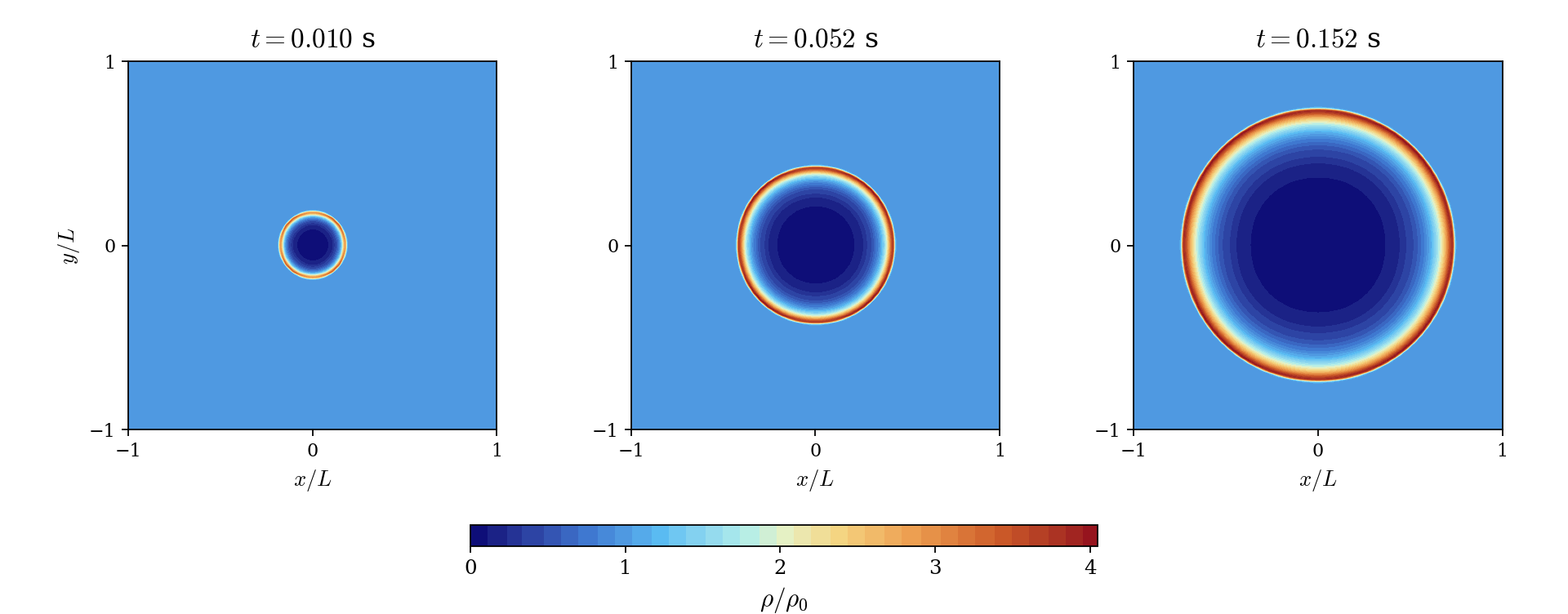
Figure 1: Normalized density $\rho/\rho_0$ at three times, with axes normalized by the domain size $L = 0.2$ m (the quarter-plane solution is mirrored across the two symmetry axes to display the full cylindrical blast; all panels share the same color scale).
The solution shows the classical Sedov structure: a thin dense shell right behind the shock and a nearly evacuated core. The peak density reaches \(\rho/\rho_0 \approx 4\), approaching the strong-shock limit \((\gamma+1)/(\gamma-1) = 6\) from below (the shock here has a finite strength, and the first-order scheme smears the peak over a few cells). The front remains circular on the cartesian grid: measuring the shock radius along rays at \(0\), \(45\) and \(90\) degrees gives a relative anisotropy of \(0.5\%\) on average (max \(1.9\%\)).
Shock trajectory vs the Sedov similarity law
The shock radius \(R(t)\) is extracted from the time-resolved EnSight output as the position of the maximum radial pressure gradient along the domain diagonal.
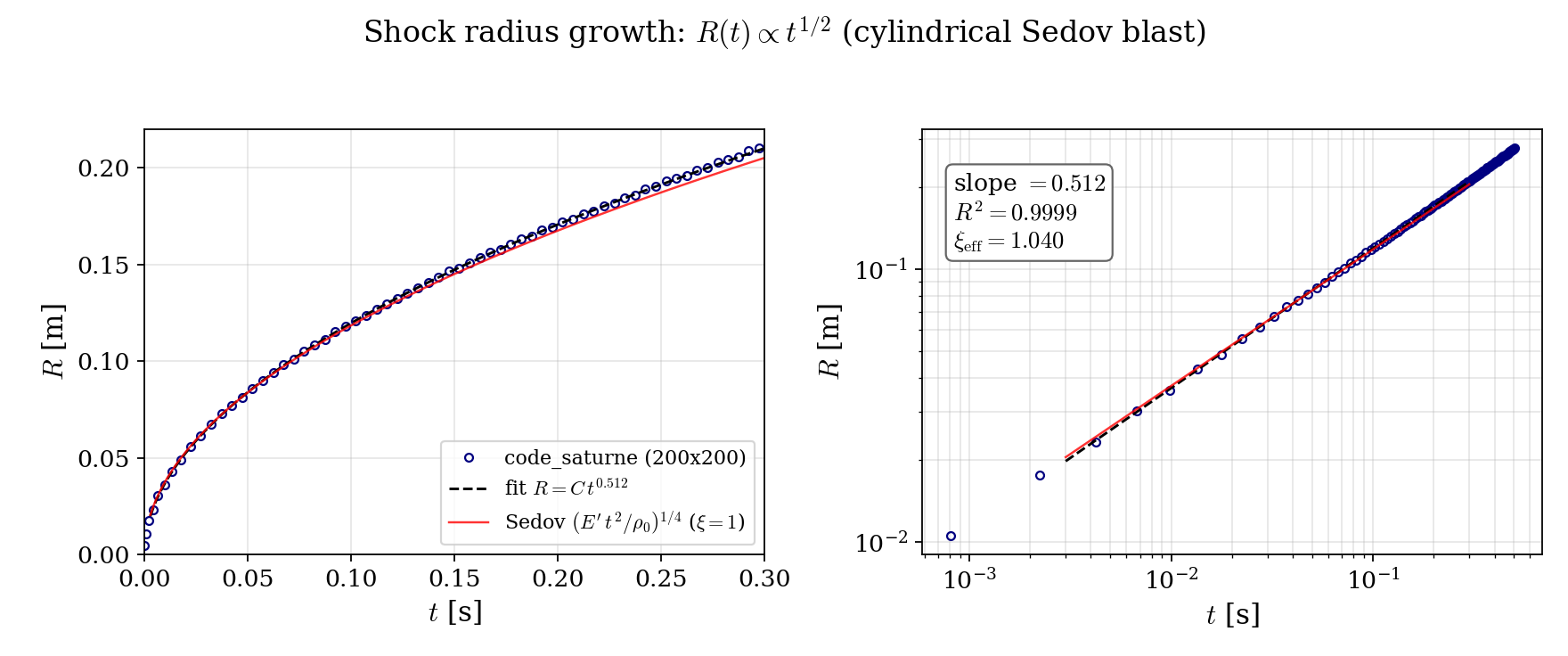
Figure 2: Shock radius versus time in linear (left) and log-log (right) scales: code_saturne (circles), power-law fit (dashed) and dimensional Sedov law $(E' t^2/\rho_0)^{1/4}$ with $\xi = 1$ (red).
Two quantitative checks:
- Exponent: the log-log fit over \(0.004 \le t \le 0.24\) s gives \(R \propto t^{0.512}\) with \(R^2 = 0.9999\), against the theoretical \(t^{1/2}\). The small excess comes from the finite size of the initial deposit (self-similarity is only reached for \(R \gg r_0\)) and from the gradient-based detection.
- Prefactor: the fitted prefactor corresponds to an effective similarity constant \(\xi_\mathrm{eff} = 1.04\), of order one as required by the theory, and within a few percent of the dimensional estimate \(\xi = 1\).
Summary
This tutorial set up a cylindrical Sedov blast wave with the compressible module of code_saturne: energy deposit through a user initialization routine, quarter-plane symmetry, supersonic outlets and a CFL-controlled variable time step. The computed shock follows the self-similar law \(R \propto t^{1/2}\) with exponent \(0.512\) (\(R^2 = 0.9999\)) and an order-one similarity constant, the total energy is conserved to better than \(10^{-4}\), and the front stays circular within \(1\%\) on the cartesian grid. Together with the Sod tube, it covers the two canonical compressible verification problems before application-oriented cases.
References
- L.I. Sedov. Similarity and Dimensional Methods in Mechanics, Academic Press, 1959.
- G.I. Taylor. The formation of a blast wave by a very intense explosion, Proc. R. Soc. Lond. A, 201:159-174, 1950.
- code_saturne documentation
Authors
Simvia - Questions, remarks and requests are welcome.