Turbulent Premixed Flame (cogz, Eddy Break-Up)
A step-by-step tutorial on the premixed side of the gas combustion module
(cogz) of code_saturne, using the Eddy Break-Up model (EBU). A uniform
fresh propane-air premix flows up past a thin central burnt-gas pilot;
the pilot anchors a rod-stabilized V-flame that spreads outward into the
fresh gas as a turbulent flame brush.
It is the premixed counterpart of the Cogz_Diffusion_Flame tutorial: there the fuel and air enter separately and burn where they mix (non-premixed); here they are already mixed and the flame propagates through them (premixed).
Maintained by Simvia, part of the tutoriel-code_saturne collection.
Learning objectives
After completing this tutorial you will be able to:
- Activate the EBU premixed combustion model (
ebu) through the GUI. - Declare a fresh-premix inlet (unburned gas) and a burnt-gas pilot inlet to anchor the flame, setting the premix mixture fraction and the fresh/burnt temperatures.
- Read a premixed flame result: the progress variable (fresh to burnt) and the temperature, and recognise the turbulent flame brush that separates fresh reactants from hot products.
Prerequisites
| Requirement | Detail |
|---|---|
| code_saturne | v9.1 (see the note below) |
| Tutorials | Cogz_Diffusion_Flame (the non-premixed counterpart) |
Version note. This case runs on code_saturne 9.1. The EBU model crashes on 9.0.0 (a segmentation fault in the legacy Fortran source-term routine
cs_f_ebutss), which 9.1 replaced with a clean C++ implementation. This is the mirror image of the diffusion-flame tutorial, whosed3pmodel is clean on 9.0.0 but broken on 9.1. Together the two cases run on the two versions: diffusion flame on 9.0.0, premixed flame on 9.1.
Case files
Cogz_Premixed_Flame/
├── CASE/
│   └── DATA/
│       ├── setup.xml      # GUI: EBU model, mesh, premix + pilot inlets, symmetry sides, time
│       └── dp_C3P         # propane-air thermochemistry (shipped with the case)
├── FIGURES/
└── README.md
The whole case is built in the GUI, with no user C routines.
dp_C3Pis the same standard propane-air thermochemistry file as in the diffusion-flame tutorial, copied intoDATA/.
Physical model
In a premixed flame the fuel and oxidizer are mixed before they reach the
flame, so combustion is limited by how fast a flame front can propagate through
the reactants, not by mixing of separate streams. The Eddy Break-Up model
represents this with a progress variable (here c = 1 -fresh-gas fraction,
so c = 0 in fresh reactants and c = 1 in burnt products). The mean reaction
rate is controlled by the turbulent time scale k/\varepsilon: turbulence
wrinkles and thickens the flame, and the model burns the reactants at a rate set
by the turbulent mixing. Temperature is a direct function of the progress
variable, from the fresh temperature to the burnt (adiabatic) temperature.
The enthalpy_mixture_st option transports the progress variable, the mixture
fraction and the enthalpy. The lateral boundaries are symmetry planes,
so the burner is effectively unconfined and the flame is adiabatic.
Chemistry is set by dp_C3P: propane (C3H8) and air, here as a stoichiometric
premix.
Flow parameters
| Quantity | Value |
|---|---|
| Domain | \(0.15 \times 0.60\) m (2D slice, \(x\) across, \(z\) up), unconfined (symmetry sides) |
| Mesh | \(60 \times 120\) cells (cartesian) |
| Fresh premix inlet | propane-air, \(2.0\) m/s, \(300\) K, mixture fraction \(0.06\) (stoichiometric) |
| Burnt pilot (centre, 1 cm) | burnt gas, \(2.0\) m/s, \(2000\) K, same mixture |
| Combustion model | EBU, enthalpy_mixture_st (adiabatic) |
| Turbulence | \(k\)-\(\varepsilon\) |
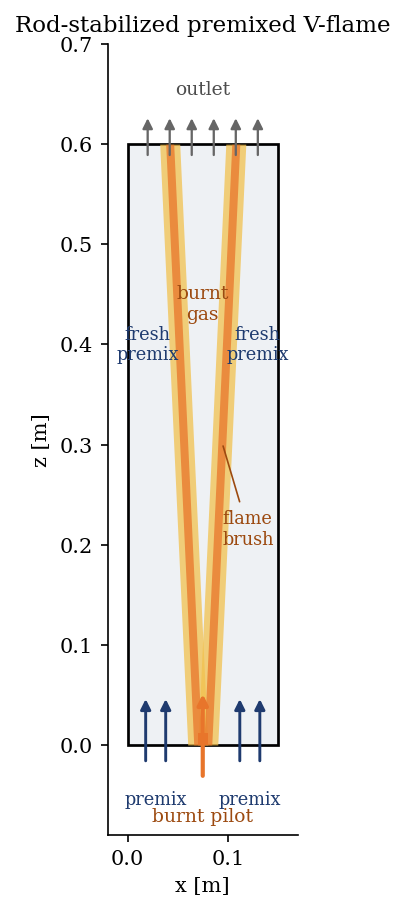
Figure 1: rod-stabilized premixed V-flame. A central burnt-gas pilot (rust)
anchors two flame fronts that open outward into the fresh premix (blue). The V
does not reach the sides, so fresh premix still flows along both walls.
Geometry and boundary conditions
A 2D slice with \(z\) vertical (flow up) and \(x\) across. The bottom face is split
into a thin central pilot inlet (Z0 with \(0.070 < x < 0.080\), gas type
burned at \(2000\) K) and a fresh-premix inlet (the rest of Z0, gas type
unburned at \(300\) K). Both carry the same stoichiometric propane-air mixture.
The top (Z1) is a free outlet; all lateral faces (X0/X1 and the
spanwise Y0/Y1) are symmetry planes, so the burner is unconfined (see the
note above on why walls are avoided here).
Numerical setup
Everything is selected in the GUI: the EBU model with the dp_C3P data file, a
\(k\)-\(\varepsilon\) turbulence model, a cartesian mesh and the two inlet zones plus
the outlet and symmetry boundaries. The run advances to a near-steady state
(\(2500\) time steps, \(\Delta t = 2\times 10^{-3}\) s).
Running the simulation
cd CASE
code_saturne run --n 4
Each run writes a timestamped CASE/RESU/<id>/ with run_solver.log and the
EnSight Gold output under postprocessing/.
Results and verification
A V-flame. The pilot anchors the flame at the burner; the two flame fronts
open outward as they rise, so the burnt-gas core widens with height while the
fresh premix is consumed from the inside out. The progress variable makes this
explicit: c = 0 (fresh) on the sides, c = 1 (burnt) in the growing central
region, with a thin flame brush between them.
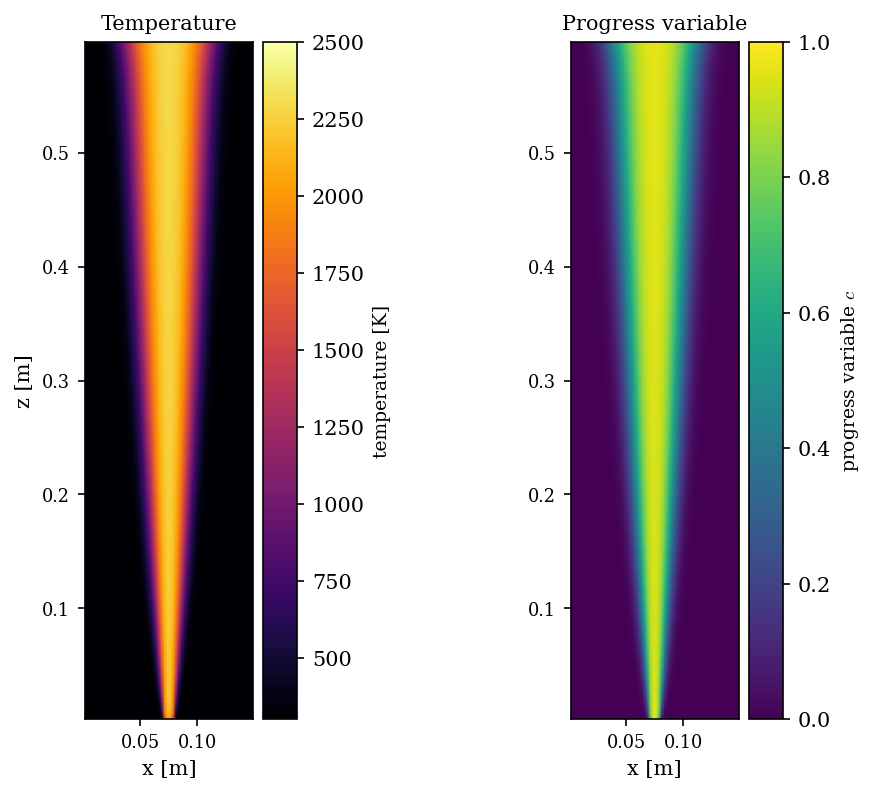
Figure 2: temperature (left) and progress variable (right). The burnt core
widens with height as the flame fronts propagate into the fresh premix.
Flame brush. A transverse cut at several heights shows the two flame fronts (steep temperature rise) moving outward as the height increases, the V signature: the hot central region grows and the cool fresh premix is pushed toward the walls.
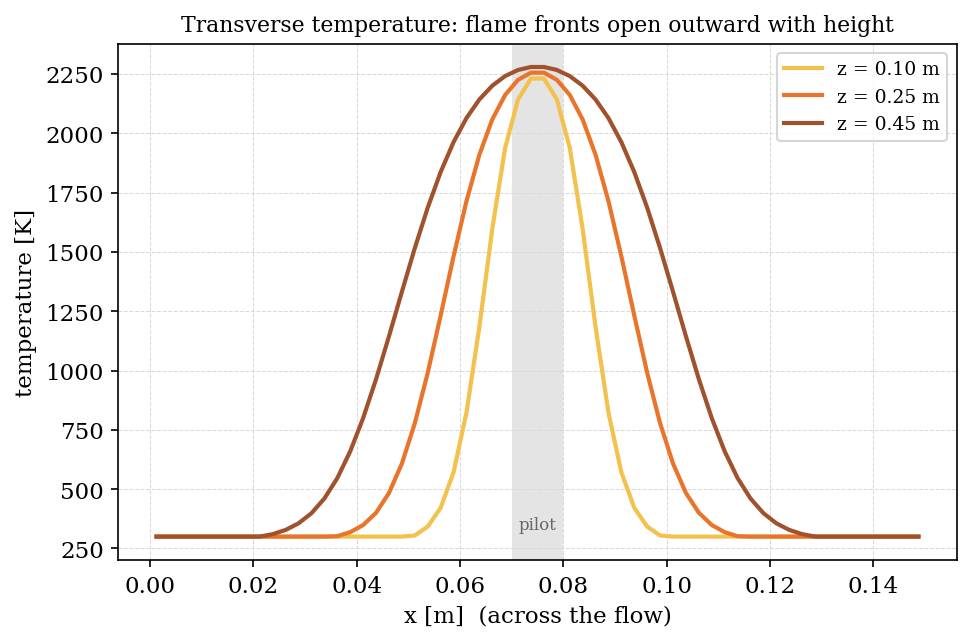
Figure 3: transverse temperature at three heights. The flame fronts open
outward with height, the V-flame signature.
The burnt-gas temperature reaches about \(2293\) K, essentially the adiabatic complete-combustion temperature of stoichiometric propane-air (about \(2270\) K). The small excess is because the infinitely-fast EBU chemistry burns to complete products and ignores dissociation, which in reality shaves off the last tens of kelvin. The point of the case is the premixed flame behaviour (progress variable, flame brush, turbulent flame propagation), which the peak temperature confirms is physically sound.
Summary
This tutorial activated the cogz module with the EBU premixed model,
entirely from the GUI: a stoichiometric propane-air premix, a burnt-gas pilot to
anchor the flame, on an unconfined (symmetry-bounded) burner. The result is a
textbook rod-stabilized V-flame with a turbulent flame brush separating fresh
reactants from hot products. With the
Cogz_Diffusion_Flame case, the pair covers the two
fundamental combustion regimes: non-premixed (diffusion) and premixed.
References
- N. Peters. Turbulent Combustion, Cambridge University Press, 2000.
- D. B. Spalding. Mixing and chemical reaction in steady confined turbulent flames, Proc. Combust. Inst. 13, 649-657, 1971 (Eddy Break-Up).
- code_saturne documentation
Authors
Simvia. Questions, remarks and requests are welcome.