Sod Shock Tube
A step-by-step tutorial for simulating the classical Sod shock tube with the compressible module of code_saturne, and validating the result against the exact solution of the Riemann problem. This is the entry case of the compressible series: one dimensional, inviscid, with an analytic reference for every wave of the solution.
Maintained by Simvia, part of the tutoriel-code_saturne collection.
Learning objectives
After completing this tutorial you will be able to:
- Enable the compressible module (constant \(\gamma\) perfect gas) in code_saturne from the GUI.
- Build a mesh with the built-in cartesian mesher (no mesh file needed).
- Initialize a discontinuous state with volume zones and per-zone formulas.
- Run a time-accurate transient with a fixed time step chosen from an acoustic CFL condition.
- Validate a shock-capturing computation against the exact Riemann solution.
Prerequisites
| Requirement | Detail |
|---|---|
| code_saturne | v9.1 |
| Background | Basic notions of gas dynamics (shock, contact, rarefaction) |
If code_saturne is not yet installed, build it from the official homepage, pull a ready-to-use Singularity image from the Open Simulation Center, or pull the Simvia Docker image before continuing.
Case files
Comp_Sod_Tube/
├── CASE/
│   └── DATA/
│       └── setup.xml          # pre-configured GUI case
├── FIGURES/                   # figures used in this README
└── README.md
There is no MESH directory: the mesh is generated at run time by the cartesian mesher configured in
setup.xml(Mesh > Cartesian mesh in the GUI).
Physical model
The flow is one-dimensional, unsteady and inviscid: the Euler equations for a perfect gas,
solved with the code_saturne compressible module (constant gamma thermodynamics, total energy as thermal variable). The molecular viscosity, the volume viscosity and the thermal conductivity are set exactly to zero through GUI user laws (e.g. molecular_viscosity = 0.0;): the GUI does not accept zero for a constant molecular viscosity, but a user-law formula can be zero. The computation therefore solves the Euler equations exactly. The heat capacity ratio comes from the perfect gas constants entered in the GUI: \(\gamma = c_p / (c_p - R/M) = 1005/(1005 - 287.06) = 1.4\).
The Riemann problem consists of two uniform states separated by a diaphragm at \(x = 0\), released at \(t = 0\):
| State | \(\rho\) | \(u\) | \(p\) |
|---|---|---|---|
| Left (\(x < 0\)) | \(1.0\) | \(0\) | \(1.0\) |
| Right (\(x \ge 0\)) | \(0.125\) | \(0\) | \(0.1\) |
The exact solution (Toro, 2009) is self-similar and contains, from left to right: a rarefaction wave, a contact discontinuity and a shock wave.
The states use the classical unit-free convention of the benchmark (\(p\) and \(\rho\) of order one). Only \(\rho\), \(p\) and \(\gamma\) matter for the inviscid dynamics; the associated temperatures are not physically meaningful.
Flow parameters
| Quantity | Symbol | Value | Source in setup.xml |
|---|---|---|---|
| Heat capacity ratio | \(\gamma\) | \(1.4\) | derived from specific_heat and reference_molar_mass |
| Left/right density | \(\rho_L\), \(\rho_R\) | \(1.0\), \(0.125\) | density formulas on zones Left/Right |
| Left/right pressure | \(p_L\), \(p_R\) | \(1.0\), \(0.1\) | pressure formulas on zones Left/Right |
| Left sound speed | \(c_L = \sqrt{\gamma p_L/\rho_L}\) | \(1.183\) | derived |
| Domain | \(x \in [-1, 1]\) | \(8000\) uniform cells | mesh_cartesian |
| Time step | \(\Delta t\) | \(1.1416 \times 10^{-4}\ \mathrm{s}\) (fixed) | time_step_ref |
| Final time | \(t_{end}\) | \(0.199\ \mathrm{s}\) (\(1744\) iterations) | iterations |
The fixed time step corresponds to a maximum acoustic CFL of \(\max(|u|+c)\,\Delta t / \Delta x \approx 1.0\) over the converged solution.
Geometry and boundary conditions
The domain is a thin box of \(2 \times 0.01 \times 1\) m meshed with \(8000 \times 1 \times 1\) cells: a 1D problem computed on a 3D mesh. All six boundaries are symmetry planes: the waves never reach the ends of the tube before \(t_{end}\), so no inlet or outlet condition is needed.
The initial discontinuity is built with two volume zones defined by selection criteria (x < 0 and x >= 0), each carrying its own initialization formulas for the density and the pressure; the velocity is zero everywhere.
| Boundary | Nature | Zone / selection |
|---|---|---|
| all six faces | Symmetry | X0, X1, Y0, Y1, Z0, Z1 |
Left (volume) |
Initialization \(\rho = 1\), \(p = 1\) | x < 0 |
Right (volume) |
Initialization \(\rho = 0.125\), \(p = 0.1\) | x >= 0 |
Numerical setup
| Setting | Value | Rationale |
|---|---|---|
| Compressible algorithm | pressure-based, constant gamma |
code_saturne compressible module |
| Time-stepping | Fixed time step | Time-accurate transient (self-similar solution) |
| Time step | \(1.1416 \times 10^{-4}\ \mathrm{s}\) | Acoustic CFL \(\approx 1\) on the finest wave speed |
| Iterations | \(1744\) | Reaches \(t = 0.199\) s before any wave hits a boundary |
| Convection scheme | 1st-order upwind (velocity, energy) | Robust, monotone shock capturing |
| Viscosities, conductivity | \(0\) (user laws) | Exact Euler limit; a GUI constant cannot be zero, a user law can |
| Turbulence | none | Inviscid benchmark |
Running the simulation
The commands below start from the tutorial directory:
cd Comp_Sod_Tube/
Option A: Graphical interface
code_saturne gui CASE/DATA/setup.xml &
The GUI opens the pre-configured setup.xml. Review the setup if you wish
(in particular Mesh > Cartesian mesh and the two initialization zones),
then launch the run with the gear (Run) button in the toolbar.
Option B: Command line
The command-line launcher is run from inside the case directory:
cd CASE

# serial
code_saturne run

# parallel (e.g. 2 MPI ranks)
code_saturne run --n 2
Each run creates a time-stamped directory CASE/RESU/<YYYYMMDD-HHMM>/ containing:
run_solver.log: solver log and residual history,postprocessing/: volume and boundary fields in EnSight Gold format (final time).
Results and verification
The figure below compares the computed profiles at \(t = 0.199\) s with the exact solution of the Riemann problem (computed with an exact iterative Riemann solver following Toro, 2009).
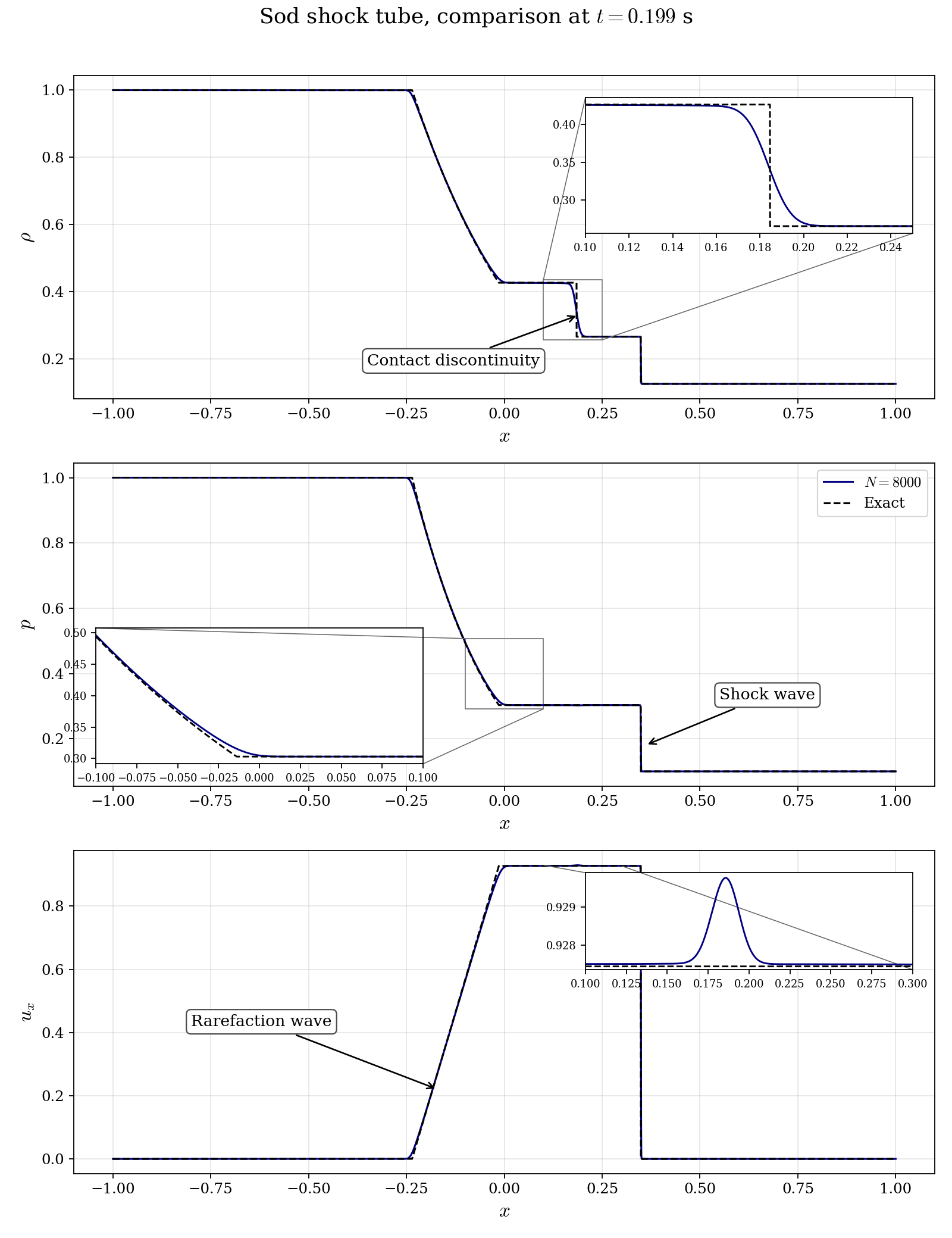
Figure 1: Density (top), pressure (middle) and x-velocity (bottom) at $t = 0.199$ s: code_saturne with 8000 cells (solid) vs exact Riemann solution (dashed), with zooms on the contact discontinuity, the rarefaction foot and the post-shock plateau.
The three waves are quantitatively reproduced:
- The shock position, strength and speed match the exact solution; the shock is captured over a few cells.
- The rarefaction wave matches the exact fan, with a slight rounding at its foot (visible in the pressure zoom), typical of the first-order upwind scheme.
- The contact discontinuity is the most smeared feature (about \(0.02\) m, i.e. \(\sim 85\) cells at 10-90%): a contact carries no pressure jump to steepen it, so a first-order scheme diffuses it steadily. This is the expected behavior, honestly visible in the density zoom.
- A tiny velocity bump (\(< 0.1\%\) of \(u\)) subsists at the contact position (velocity zoom), also a known artifact of pressure-based shock capturing.
The mean absolute errors over the domain are \(\overline{|\Delta \rho|} = 1.0 \times 10^{-3}\), \(\overline{|\Delta p|} = 5.5 \times 10^{-4}\) and \(\overline{|\Delta u|} = 1.0 \times 10^{-3}\).
Summary
This tutorial set up the Sod shock tube with the compressible module of code_saturne: constant \(\gamma\) perfect gas, cartesian built-in mesh, discontinuous initialization by volume zones, a 1st-order upwind convection scheme, and a fixed time step at acoustic CFL \(\approx 1\). The computed rarefaction, contact and shock match the exact Riemann solution, with the expected first-order smearing of the contact discontinuity. This case is the natural starting point before multi-dimensional compressible cases (blast waves, supersonic ramps).
References
- G.A. Sod. A survey of several finite difference methods for systems of nonlinear hyperbolic conservation laws, Journal of Computational Physics, 27(1):1-31, 1978.
- E.F. Toro. Riemann Solvers and Numerical Methods for Fluid Dynamics, 3rd edition, Springer, 2009 (chapters 4-5).
- code_saturne documentation
Authors
Simvia - Questions, remarks and requests are welcome.