Unsaturated Flow with the Van Genuchten Model (CDO)
A step-by-step tutorial for variably saturated flow in the groundwater flow (GWF) module of code_saturne: the nonlinear Richards equation with the Van Genuchten-Mualem constitutive laws. Where the saturated cases (Gwf_Darcy_Tracer and the two tracer variants) keep the soil fully wet, this case resolves the unsaturated zone: a soil column drains toward hydrostatic equilibrium above a water table, and the moisture profile settles onto the Van Genuchten retention curve. That curve, and the constant equilibrium head, are the validation references.
Maintained by Simvia, part of the tutoriel-code_saturne collection.
Learning objectives
After completing this tutorial you will be able to:
- Activate the unsaturated single-phase groundwater model with gravity
(
CS_GWF_MODEL_UNSATURATED_SINGLE_PHASE,CS_GWF_GRAVITATION). - Define a Van Genuchten-Mualem soil (
CS_GWF_SOIL_VGM_SINGLE_PHASE,cs_gwf_soil_set_vgm_spf_param). - Set a spatially varying initial hydraulic head with an analytic function.
- Understand the pressure head / elevation split and validate the drained column against the Van Genuchten retention curve and hydrostatic equilibrium.
Prerequisites
| Requirement | Detail |
|---|---|
| code_saturne | v9.1 (built with the CDO module, default) |
| Tutorials | Gwf_Darcy_Tracer (the saturated base case, read it first) |
If code_saturne is not yet installed, build it from the official homepage, pull a ready-to-use Singularity image from the Open Simulation Center, or pull the Simvia Docker image before continuing.
Case files
Gwf_Unsaturated_VanGenuchten/
├── CASE/
│   ├── DATA/setup.xml               # vertical column mesh, time stepping, output
│   └── SRC/
│       ├── cs_user_zones.cpp        # volume zone + bottom (water table) zone
│       └── cs_user_parameters.cpp   # GWF model, VGM soil, gravity, BC/IC
├── FIGURES/
└── README.md
No mesh file: the vertical column is built by the built-in cartesian mesher.
Physical model
In an unsaturated porous medium the pores are only partly water-filled, and both the water content and the conductivity depend on the pressure head \(h\) (negative = suction). The flow obeys the Richards equation
with \(H\) the hydraulic head and \(z\) the elevation. code_saturne closes it with the Van Genuchten-Mualem laws:
A soil column, initially saturated, sits on a fixed water table (\(H = 0\)) and is closed at the top. Water drains down and out the bottom until the flux vanishes. At that hydrostatic equilibrium \(H\) is uniform, so the pressure head is \(h = H - z = -z\): the moisture content then follows the retention curve \(\theta(-z)\), decreasing from saturation at the water table to residual values higher up (the capillary fringe).
Soil parameters (a silt-loam type soil)
| Quantity | Symbol | Value |
|---|---|---|
| Column height | \(H_\mathrm{col}\) | \(2\) m (\(100\) cells) |
| Saturated conductivity | \(K_s\) | \(2.9\times10^{-6}\) m/s |
| Saturated water content | \(\theta_s\) | \(0.43\) |
| Residual water content | \(\theta_r\) | \(0.078\) |
| Van Genuchten scaling | \(\alpha\) | \(3.6\) m⁻¹ |
| Van Genuchten shape | \(n\) | \(1.56\) |
| Mualem tortuosity | \(L\) | \(0.5\) |
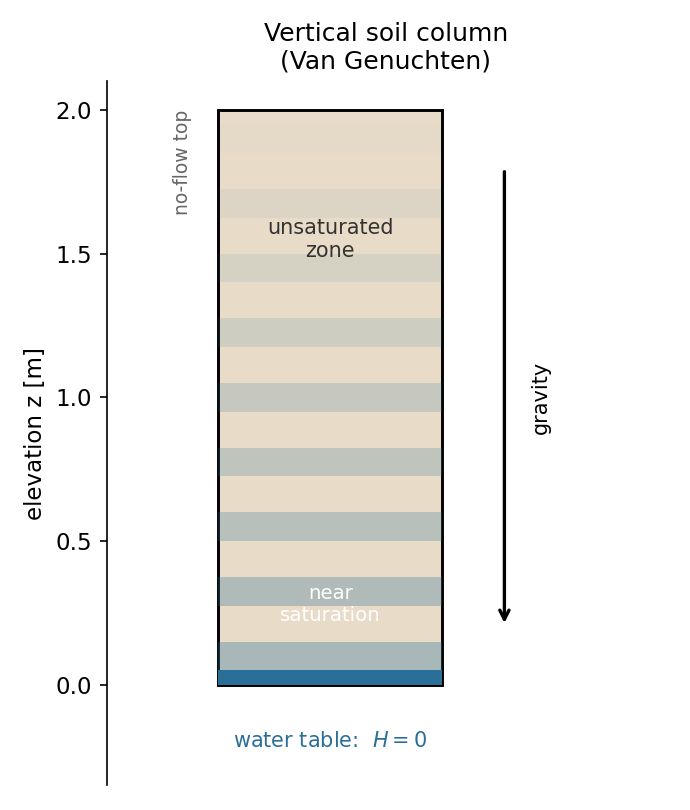
Figure 1: the vertical column. A fixed water table at the bottom ($H = 0$) and a no-flow top; the column drains under gravity to a capillary-fringe moisture profile.
Geometry and boundary conditions
The column is vertical (\(y\) is the elevation). The bottom face (bottom, group
Y0) is the water table with an imposed hydraulic head \(H = 0\); every other face
is no-flow (CS_BOUNDARY_SYMMETRY). The column starts fully saturated: the
initial hydraulic head is set to \(H = y\) (pressure head zero everywhere) with an
analytic function.
Numerical setup
Unsaturated single-phase CDO model with gravity. The Richards equation is nonlinear (through \(\theta(h)\) and \(K(h)\)) and unsteady; the run uses \(\Delta t = 10^4\) s for \(4000\) steps (\(4\times10^7\) s), long enough for the column to reach hydrostatic equilibrium (the dry upper soil has a very low conductivity, so the last approach to equilibrium is slow).
Elevation direction. The module builds the pressure head as \(h = H - (\mathbf{x}\cdot\mathbf{g})\), so the vector
gravityis used as the unit vector along which the elevation head is measured. For a column vertical along \(+y\) it is set to \((0, 1, 0)\) incs_user_model, giving \(h = H - y\).
Running the simulation
cd CASE
code_saturne run --n 4
The mesh is generated internally. The run writes CASE/RESU/<id>/ with the
hydraulic head, the pressure head, the liquid saturation (water content) and the
permeability in postprocessing/.
Results and verification
Drainage to equilibrium. Starting from saturation, the column drains from the top downward. The moisture profiles at successive times converge onto the Van Genuchten equilibrium profile \(\theta(-z)\); at the final time the hydraulic head is uniform to \(H \lesssim 0.01\) m (hydrostatic equilibrium) and the pressure head is \(h = -z\) to within \(0.01\) m over the whole column.
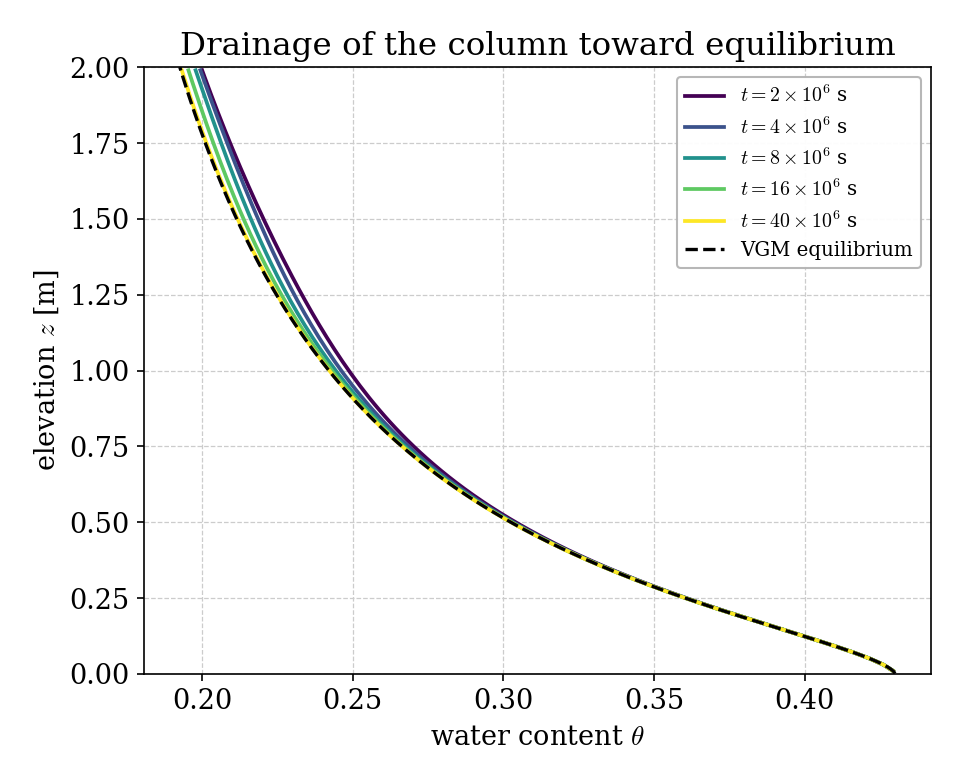
Figure 2: water content $\theta(z)$ at successive times, draining toward the Van Genuchten equilibrium profile (dashed). The lower soil stays near saturation; the upper soil dries to the capillary-fringe values.
Retention curve. Plotting the computed water content of every cell against its pressure head recovers the Van Genuchten retention curve exactly (maximum deviation \(4\times10^{-4}\)): from \(\theta_s = 0.43\) at zero suction down toward the residual content at \(2\) m of suction. This is the constitutive law the solver integrates, verified pointwise across the column.
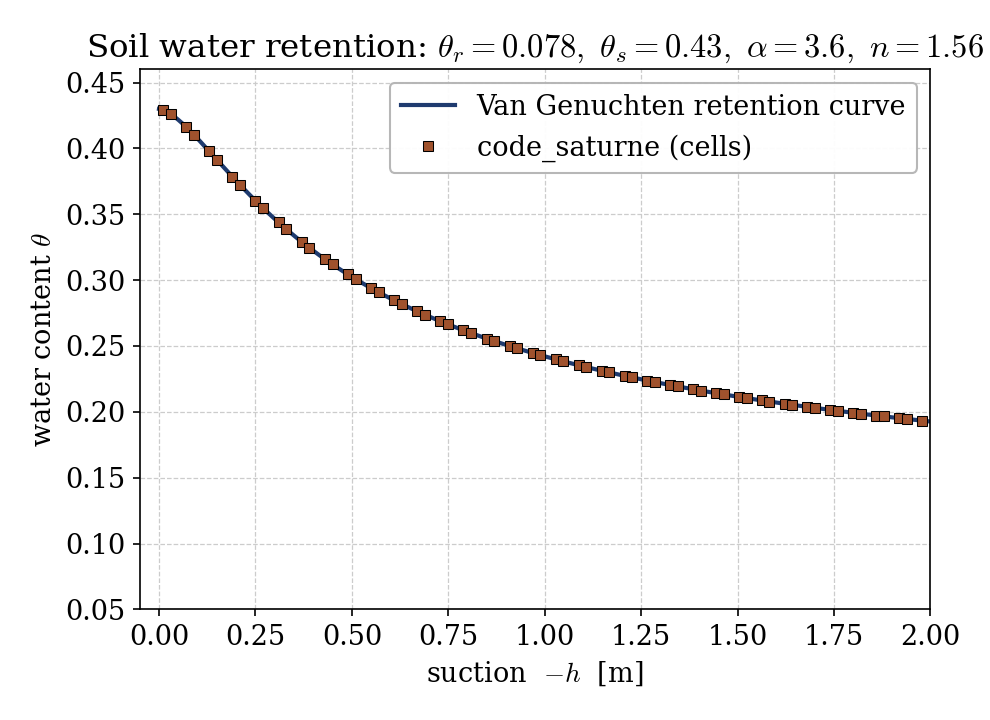
Figure 3: soil water retention curve. The cell values (symbols) lie on the Van Genuchten curve (line), confirming the constitutive model.
Summary
This tutorial solved a nonlinear, variably saturated flow with the unsaturated
groundwater model: a saturated column drained under gravity to hydrostatic
equilibrium above a water table. The equilibrium hydraulic head is uniform and
the moisture profile follows the Van Genuchten retention curve, both recovered by
the solver to better than \(10^{-2}\) m and \(10^{-3}\) in water content. The lesson
that carries beyond this case: unsaturated groundwater flow adds the strongly
nonlinear \(\theta(h)\) and \(K(h)\) closures to Darcy's law, and code_saturne
provides them through the Van Genuchten-Mualem soil model, set up with a single
cs_gwf_soil_set_vgm_spf_param call.
References
- M. Th. van Genuchten. A closed-form equation for predicting the hydraulic conductivity of unsaturated soils, Soil Science Society of America Journal 44, 892-898, 1980.
- Y. Mualem. A new model for predicting the hydraulic conductivity of unsaturated porous media, Water Resources Research 12, 513-522, 1976.
- code_saturne documentation
Authors
Simvia. Questions, remarks and requests are welcome.