Large-Eddy Simulation of a Turbulent Channel (WALE)
A step-by-step tutorial for scale-resolving turbulence in code_saturne: a wall-resolved Large-Eddy Simulation (LES) of the fully-developed turbulent channel at \(Re_\tau = 180\). Where the RANS counterpart (Inc_Turbulent_Channel) models all of the turbulence, the LES resolves the energy-containing eddies and models only the sub-grid scales. The tutorial's purpose is the LES workflow: a 3D periodic box driven by a momentum source, transition triggered from a perturbed field, and time-averaged statistics accumulated in-solver, validated against the law of the wall and the resolved Reynolds stresses.
Maintained by Simvia, part of the tutoriel-code_saturne collection.
Learning objectives
After completing this tutorial you will be able to:
- Set up a wall-resolved LES (WALE sub-grid model) on a 3D periodic box built with the built-in cartesian mesher.
- Drive the flow with a constant momentum source term and trigger transition from a perturbed initial field.
- Accumulate time-averaged statistics in-solver (mean velocity and the Reynolds stress tensor) with code_saturne's time moments.
- Validate the mean profile against the law of the wall and inspect the resolved Reynolds stresses that an eddy-viscosity RANS model cannot represent.
Prerequisites
| Requirement | Detail |
|---|---|
| code_saturne | v9.1 |
| Tutorials | Inc_Turbulent_Channel (the RANS counterpart, same driving), Inc_Streamwise_Periodic |
If code_saturne is not yet installed, build it from the official homepage, pull a ready-to-use Singularity image from the Open Simulation Center, or pull the Simvia Docker image before continuing.
Case files
Inc_LES_Channel/
├── CASE/
│   ├── DATA/setup.xml                    # cartesian box, periodicity, WALE LES
│   └── SRC/
│       ├── cs_user_source_terms.cpp      # constant streamwise body force f_x
│       ├── cs_user_initialization.cpp    # perturbed field to trigger turbulence
│       └── cs_user_parameters.cpp        # time-averaged statistics (moments)
├── FIGURES/
└── README.md
No mesh file: the 3D box is built by the built-in cartesian mesher.
Physical model
LES applies a spatial filter to the Navier-Stokes equations: the resolved (large) scales are computed directly, and the unresolved sub-grid scales are represented by a sub-grid viscosity. Here the WALE model (Nicoud and Ducros 1999) is used, which recovers the correct near-wall scaling without any ad hoc damping, so the LES can be integrated down to the wall.
The channel is periodic in the streamwise (\(x\)) and spanwise (\(z\)) directions and driven by a constant body force \(f_x = \rho\,u_\tau^2/h\), exactly as in the RANS channel: this fixes the friction Reynolds number by construction. Because LES fields are instantaneous, the statistics (mean profile, Reynolds stresses) are obtained by time-averaging once the flow is statistically steady, and additionally by averaging over the two homogeneous directions (\(x\), \(z\)).
The case is written in wall units: \(h = 1\), \(\rho = 1\), \(u_\tau = 1\), so \(f_x = 1\) and \(\nu = 1/Re_\tau\). Choosing \(\nu = 1/180\) gives \(Re_\tau = 180\).
Flow and grid parameters
| Quantity | Symbol | Value |
|---|---|---|
| Friction Reynolds number | \(Re_\tau\) | \(180\) |
| Box size | \(L_x \times 2h \times L_z\) | \(2\pi h \times 2h \times \pi h\) |
| Grid | \(n_x \times n_y \times n_z\) | \(48 \times 64 \times 48\) |
| Streamwise resolution | \(\Delta x^+\) | \(\approx 24\) |
| Spanwise resolution | \(\Delta z^+\) | \(\approx 12\) |
| First cell (wall) | \(\Delta y_1^+\) | \(\approx 1\) |
| Sub-grid model | WALE |
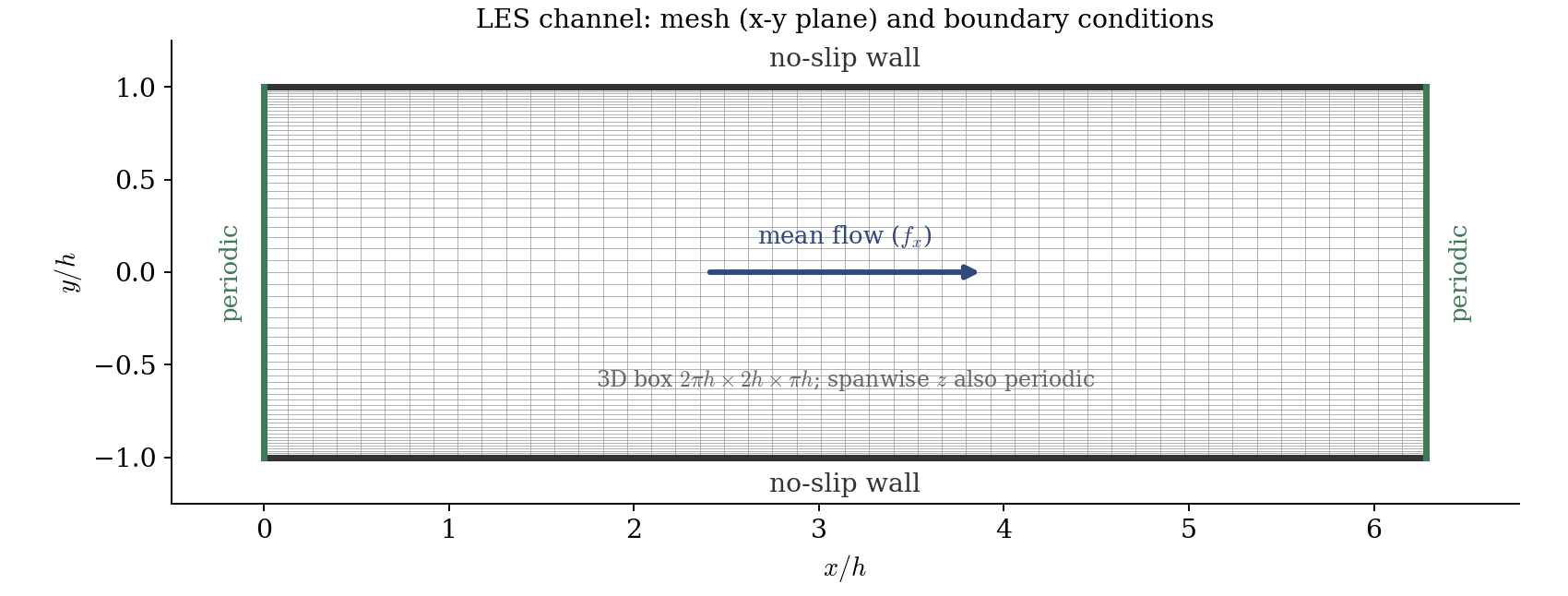
Figure 1: mesh ($x$-$y$ plane, in half-heights $h$) and boundary conditions: no-slip walls at $y = \pm h$, periodic in $x$ and $z$, driven by the momentum source $f_x$.
Numerical setup
| Setting | Value | Rationale |
|---|---|---|
| Sub-grid model | WALE, wall-resolved | resolves the near-wall turbulence |
| Convection scheme | 2nd-order centred | low numerical dissipation (essential for LES) |
| Time scheme | 2nd order | time-accurate |
| Time step | constant \(\Delta t = 3.5\times10^{-3}\) | Courant number \(\lesssim 1\) |
| Duration | \(12000\) steps | transient + averaging |
| Statistics | time moments from step \(5000\) | after the transient |
| Initialization | perturbed field (cs_user_initialization) |
trigger transition |
A laminar start would stay laminar: cs_user_initialization.cpp superimposes
coherent perturbations and random noise on a plug profile to trigger transition,
after which the body force sustains the turbulence. The statistics are defined in
cs_user_parameters.cpp as two time moments: the mean velocity \(\langle u\rangle\)
and the variance (the Reynolds stress tensor \(\langle u_i'u_j'\rangle\)), started
at step 5000 once the flow is statistically steady.
Running the simulation
cd CASE
code_saturne run --n 4
The mesh is generated internally. LES is more expensive than the RANS case
(a longer, time-accurate run); parallel execution is recommended. The run writes
CASE/RESU/<id>/ with the instantaneous fields and the time-averaged moments
u_mean and u_variance in postprocessing/.
Results and verification
Once transition is complete, the near-wall region fills with the streamwise streaks that are the signature of wall turbulence: alternating high- and low-speed elongated structures, spaced about 100 wall units apart in the spanwise direction. These are resolved by the LES, not modelled.
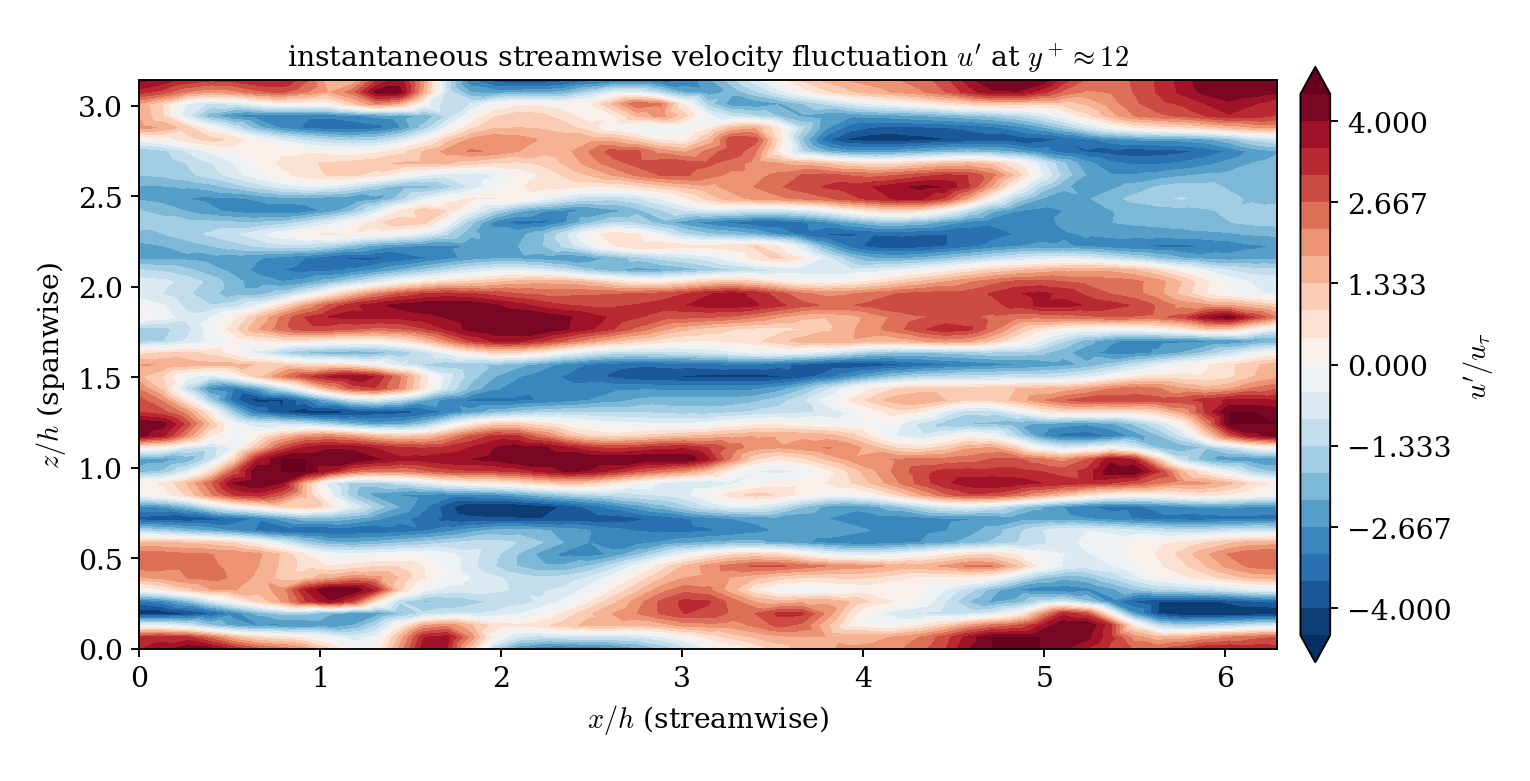
Figure 2: instantaneous streamwise fluctuation $u'$ at $y^+ \approx 12$. The elongated streaks (spaced $\approx 100$ wall units in $z$) are the resolved near-wall turbulence.
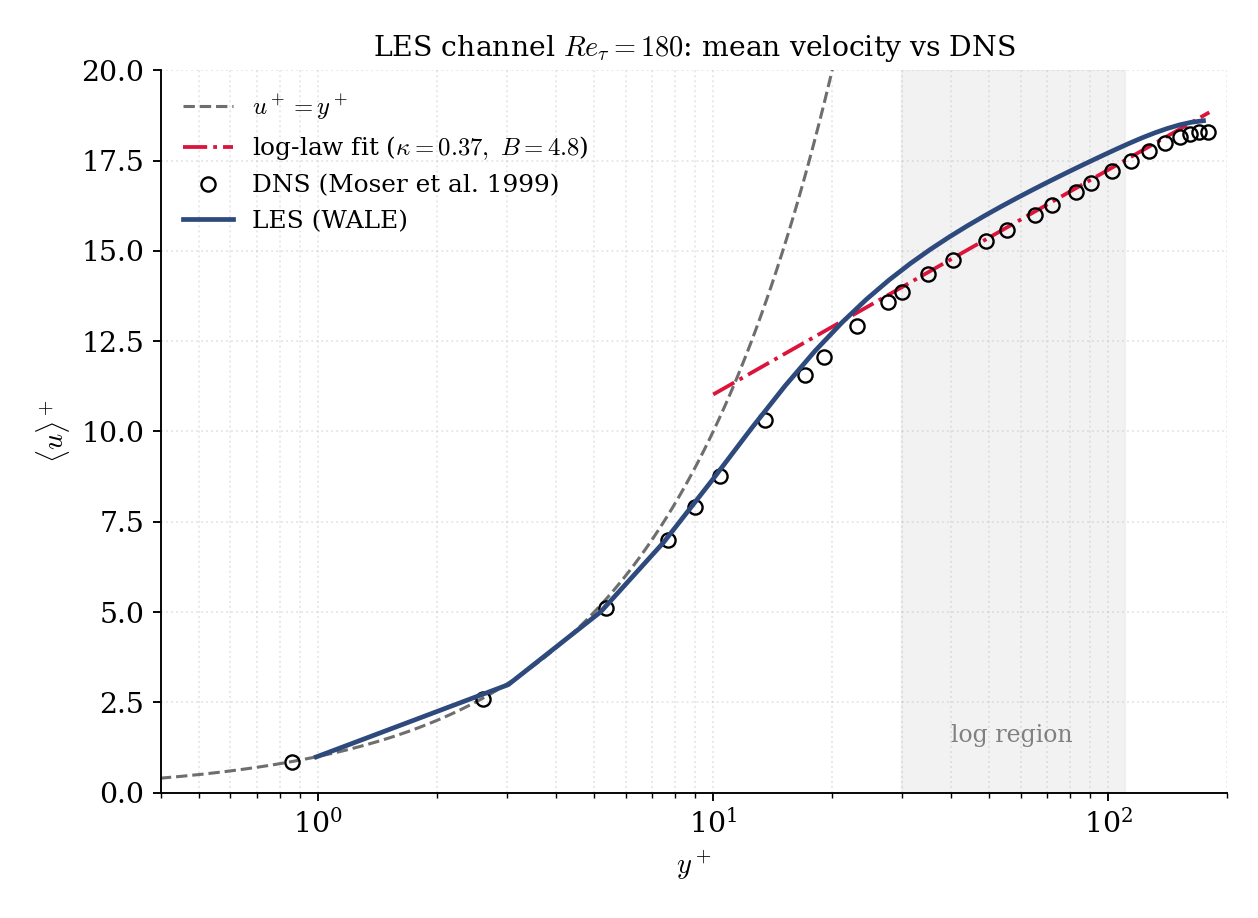
Figure 3: mean velocity $\langle u\rangle^+$ versus $y^+$, LES against the DNS of Moser et al. (1999) at the same $Re_\tau$. At this low $Re_\tau$ there is no genuine log layer; the dash-dot line is a near-wall log-law fit drawn only to guide the eye (see discussion). The LES follows the DNS.
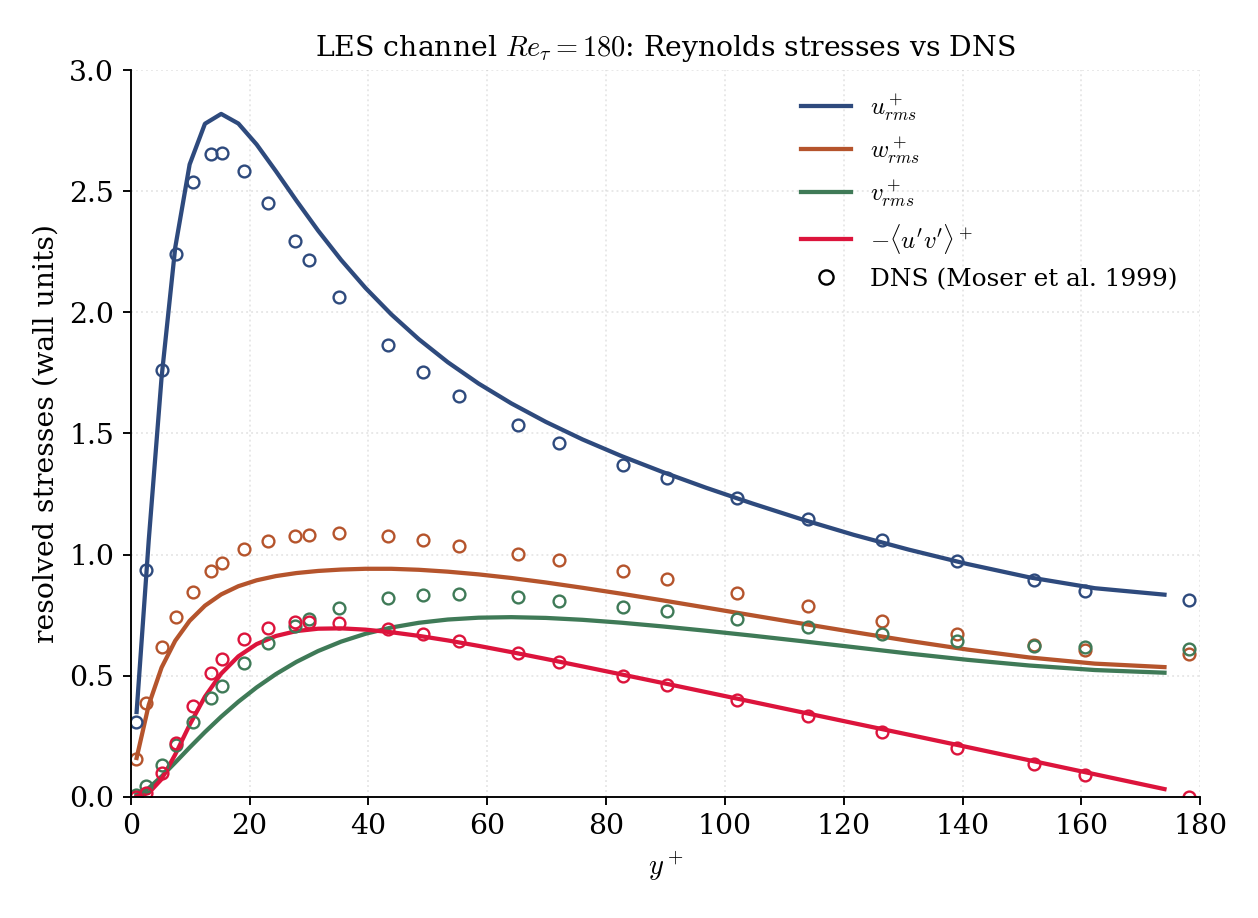
Figure 4: resolved Reynolds stresses (lines) versus the Moser et al. (1999) DNS (circles). The near-wall peaks and the shear stress $-\langle u'v'\rangle^+$ are captured, structure an eddy-viscosity RANS model cannot resolve.
The LES agrees well with the DNS (Figures 3 and 4): the mean velocity matches through the sublayer and buffer, with a small over-prediction in the outer layer (beyond \(y^+ \approx 40\)) from the moderate grid, and the resolved stresses recover the near-wall structure, the shear stress \(-\langle u'v'\rangle^+\) peaking at about \(0.70\) (DNS \(\approx 0.72\)) and the streamwise fluctuation at about \(2.8\) (DNS \(\approx 2.65\)), with a slightly too-strong near-wall anisotropy.
The statistics are converged: the top and bottom halves of every profile coincide to within a few percent (thanks to the averaging over the two homogeneous directions), the practical convergence check for the second-order moments. These residual differences from the DNS are the expected footprint of the moderate grid; the resolved streaks and Reynolds stresses are the point: scale-resolving turbulence that the RANS model can only represent statistically.
Summary
This tutorial ran a wall-resolved LES of the \(Re_\tau = 180\) turbulent channel on a 3D periodic box, driven by the same momentum source as the RANS channel, with the WALE sub-grid model and 2nd-order numerics. Transition was triggered from a perturbed field, and the statistics were accumulated in-solver as time moments and averaged over the homogeneous directions. The LES resolves the near-wall streaks and the anisotropic Reynolds stresses and matches the Moser et al. DNS closely, including the low-Reynolds mean profile that departs from the standard log law (no genuine log layer exists at \(Re_\tau = 180\)); the second-order moments are converged, verified by the top/bottom symmetry of the profiles. The lesson that carries beyond this case: LES resolves the turbulence RANS only models, at the price of a 3D, time-accurate, well-resolved and long-averaged computation.
References
- R. D. Moser, J. Kim, N. N. Mansour. Direct numerical simulation of turbulent channel flow up to \(Re_\tau = 590\), Physics of Fluids 11, 943-945, 1999.
- F. Nicoud, F. Ducros. Subgrid-scale stress modelling based on the square of the velocity gradient tensor, Flow, Turbulence and Combustion 62, 183-200, 1999.
- code_saturne documentation
Authors
Simvia. Questions, remarks and requests are welcome.